You Should know FDA Authority Over Beauty/Cosmetics

 
Sorry everyone I’m not selling hair care, or teaching haircuts, or color but what I can give you is information that you should know. I have been in the Beauty/Cosmetic industry for well over 25 years and take it from me, a product is here yesterday and gone tomorrow. In Cosmetology school there is a lack of education being given to the student on laws of products, what a manufacturer can say and not say ie (labeling, ingredient’s). What governmental agency’s are there for the protection of the independent stylist and also for the salon employee. Many, many individuals will set up blogs, websites telling you how to overcome customer relations, how to hair color, how to haircutting, and often these individuals will set up a class telling you how to make a ‘Facebook page”. I see this alot at the beauty shows in my industry. But I never really see the hard facts being given to the professional. Its easy to skirt the issues of the beauty industry, “Keep the dumb”, I say. Which to me is so very sad. Many of my fellow professionals are given a line of BS, and are insulted by manufacturers and so-called beauty icons and magazine and websites. Not really taking the issues that are needed for change in my industry, Product knowledge is what they will get and only enough education to buy a product the manufacturers are pushing. Below is important information you should know about the FDA, and how it will help you within your profession. Never, never take the sales persons,distributors or manufactures word as law in the beauty/cosmetic industry, investigate on your own and come to your on conclusions. And if you see a so-called beauty industry “ICON’ pushing a product, WATCHOUT, they are basically being paid to SELL that product!
What does the law say about cosmetic safety and labeling?
The two most important laws pertaining to cosmetics marketed in the United States are the Federal Food, Drug, and Cosmetic Act1 (FD&C Act) and the Fair Packaging and Labeling Act2 (FPLA). The Food, Drug & Cosmetic Act prohibits the marketing of adulterated or misbranded cosmetics in interstate commerce. Violations of the Act involving product composition–whether they result from ingredients, contaminants, processing, packaging, or shipping and handling–cause cosmetics to be adulterated and subject to regulatory action.
 
Under the FD&C Act, a cosmetic is adulterated if–
“it bears or contains any poisonous or deleterious substance which may render it injurious to users under the conditions of use prescribed in the labeling thereof, or under conditions of use as are customary and usual” [with an exception made for hair dyes];
“it consists in whole or in part of any filthy putrid, or decomposed substance”;
“it has been prepared, packed, or held under insanitary conditions whereby it may have become contaminated with filth, or whereby it may have been rendered injurious to health”;
“its container is composed, in whole or in part, of any poisonous or deleterious substance which may render the contents injurious to health”; or except for hair dyes, “it is, or it bears or contains, a color additive4 which is unsafe within the meaning of section 721(a)” of the FD&C Act. (FD&C Act, sec. 601).
 
Improperly labeled or deceptively packaged products are considered misbranded and subject to regulatory action. Under the FD&C Act, a cosmetic is considered misbranded if–
“its labeling is false or misleading in any particular”;
“its label does not include all required information;
“the required information is not adequately prominent and conspicuous;
“its container is so made, formed, or filled as to be misleading”;
“it is a color additive, other than a hair dye, that does not conform to applicable regulations issued under section 721 of the FD&C Act; and
“its packaging or labeling is in violation of an applicable regulation issued pursuant to section 3 or 4 of the Poison Prevention Packaging Act of 1970.” (FD&C Act, sec. 602)
In addition, under the authority of the FPLA, FDA requires an ingredient declaration to enable consumers to make informed purchasing decisions. Cosmetics that fail to comply with the FPLA are considered misbranded under the FD&C Act. It is important to understand that Congress passes the laws that govern the United States. To put those laws into effect, Congress authorizes certain government agencies, including FDA, to create and enforce regulations, but only as authorized under the law. A change in FDA’s statutory authority over cosmetics would require Congress to change the law.
Does FDA approve cosmetics before they go on the market?
FDA’s legal authority over cosmetics is different from other products regulated by the agency, such as drugs, biologic, and medical devices. Cosmetic products and ingredients are not subject to FDA premarket approval authority, with the exception of color additives. However, FDA may pursue enforcement action against violative products, or against firms or individuals who violate the law.
Must cosmetic manufacturers register with FDA?
Manufacturers are not required to register their cosmetic establishments, file data on ingredients, or report cosmetic-related injuries to FDA. However, companies are encouraged to register their establishments and file Cosmetic Product Ingredient Statements with FDA’s Voluntary Cosmetic Registration Program11 (VCRP).
Can FDA inspect cosmetic manufacturers?
FDA can and does inspect cosmetic manufacturing facilities10 to assure cosmetic product safety and determine whether cosmetics are adulterated or misbranded under the FD&C Act or FPLA.
What actions can FDA take against firms that market adulterated or misbranded cosmetics?
FDA may take regulatory action if it has information to support that a cosmetic is adulterated or misbranded. The agency can pursue action through the Department of Justice in the federal court system to remove adulterated and misbranded cosmetics from the market. To prevent further shipment of an adulterated or misbranded product, the agency may request a federal district court to issue a restraining order against the manufacturer or distributor of the violative cosmetic. Violative cosmetics may be subject to seizure. FDA also may initiate criminal action against a person violating the law. In addition, FDA works closely with the U.S. Customs and Border Protection8 to monitor imports. Under section 801(a) of the FD&C Act, imported cosmetics9 are subject to review by FDA at the time of entry through U.S. Customs. Products that do not comply with FDA laws and regulations are subject to refusal of admission into the United States. Violative products must be brought into compliance (if feasible), destroyed, or re-exported. FDA takes regulatory action based upon agency priorities, consistent with public health concerns and available resources.
 
Can FDA order the recall of a hazardous cosmetic from the market?
Recalls of cosmetics are voluntary actions taken by manufacturers or distributors to remove from the marketplace products that represent a hazard or gross deception, or that are somehow defective. FDA categorizes a firms action as a recall (as opposed to a market withdrawal) when it determines that the product hazard or defect represents a violation of the FD&C Act. FDA is not authorized to require recalls of cosmetics but does monitor companies that conduct a product recall and may request a product recall if the firm is not willing to remove dangerous products from the market without FDA’s written request. Recalls are addressed in Title 21 of the Code of Federal Regulations (CFR), sections 7.40 through 7.59.
Who is responsible for substantiating the safety of cosmetics?
Cosmetic firms are responsible for substantiating the safety of their products and ingredients before marketing. Failure to adequately substantiate the safety of a cosmetic product or its ingredients prior to marketing causes the product to be misbranded unless the following warning statement appears conspicuously on the principal display panel of the product’s label:
“Warning–The safety of this product has not been determined.” (21 CFR 740.10)
In addition, regulations prohibit or restrict the use of several ingredients5 in cosmetic products and require warning statements6 on the labels of certain types of cosmetics. In general, except for color additives and those ingredients which are prohibited or restricted from use in cosmetics by regulation, a manufacturer may use any ingredient in the formulation of a cosmetic provided that the ingredient and the finished cosmetic are safe, the product is properly , and the use of the ingredients does not otherwise cause the cosmetic to be adulterated or  under the laws that FDA enforces.
 
Joseph Kellner Hairdresser/Mua/Film Producer
2nd Trailer for the film “Beautiful LieS”

Press Release for The Film “Beautiful LieS”
Beautiful LieS is being produced by Jotivi Designs, Inc, and will be released in December 2013. Beautiful LieS will encompass entrepreneurs, manufacture deception, ingredients, product labeling, deceptive labeling ,formulations, health and welfare, as well as uncovering what professionals are using in the salon and what is in salon/consumer products. In Beautiful LieS, we will hear from OSHA and FDA on the topics of health and welfare in beauty/cosmetic products.
“Beautiful Lies” will be completed by December 2013 and will be
available for Digital Download as well as DVD purchase.
This film was solely funded by Jotovi Designs Inc, and is not seeking any form of sponsorship.
And as of February 11, 2012 “Beautiful LieS Copy Writtent in this Website (including, without limitation, Text,Images, Software, Logos, Icons, Sounds Recordings. Films and HTML code) is owned or licensed by Jotovi Designs Inc. All editorial content and graphics on this site are protected by U.S. copyright and owned by Jotovi Designs Inc.

Suave Keratin Infusion Treatment Has Some Consumers Pulling Their Hair Out!

Dear Joseph Kellner

I bought the treatment on 3/23/12 from wal-mart and I used it a week later.  I have previously used Sallys brand about 8 months prior so I knew what I was doing and I read the directions correctly.  Not even a week after I used the Suave brand, my hair got considerably lighter, which has never happened and my hair started to fall out.  Even now, every time I was my hair, more of it breaks and I am losing it by the handfuls.  I only use the treatments because after I had my daughter, my hair got wavy and thicker only in the back and I wanted an easier way to maintain my hair.  The treatment I used before worked wonders and seeing as Suave’s was a whole lot cheaper, I took a chance.  I know it is not supposed to make it straight, but it is supposed to make it easier to straighten, and this did not do as it was supposed to.  I saw the recall at my local CVS and wanted to know what I am supposed to do from here?  Thanks for your time.
Ashley Mier

In the hair styling business, people are willing to pay big bucks for long-lasting, silky smooth locks. Keratin hair treatments now seem to be the preferred method of attaining a head-turning hairdo.

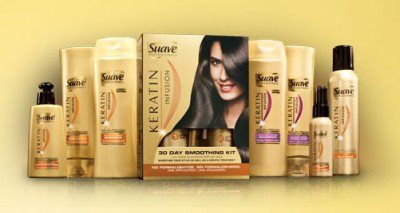
Once available only from pricy professional stylists, keratin hair treatments are now available over-the-counter in affordable do-it-yourself kits, as if do it yourself  hair color is not enough. As it turns out, these at-home treatments have left some customers with more than just extra money on their hands. Suave Keratin Infusion Treatment will give you 30 days of soft, smooth, shiny hair, though it claims. This situation brings back memory’s of the Brazilian Blowout, remember they lied about the not FORMALDHYDE. See where it got them, and it seems Suave is in a boat they created by themselves just like Brazilian Blowout.

“The Suave Professionals Keratin Infusion30-Day Smoothing Kit transforms Frizz like a salon keratin treatment-  at home! In just three easy steps, hair is sleeker, smoother and easier to style.”

A sizeable number of Suave Professionals Keratin Infusion users have taken to the internet with claims that the product has made their hair fall out. Other consumers claim to have been left with badly damaged hair requiring drastic intervention in the form of aggressive hairstyle modification (read: getting their hair chopped off). Suave has discontinued the product and provided resources to customers who have questions about the product’s safety and effectiveness. I have called Suave repeatedly to ask them information on there  recall and not to my suprise I get no answers!

This dustup “highlights” (please forgive the pun) a truly important issue in consumer product safety. That’s a key concept that consumers should remember in order to keep themselves safe: Follow the directions! Too many people are injured when they fail to heed (or even read) the manufacturer’s guidance. In some cases, of course, the product in question cannot be rendered safe or the manufacturer should anticipate consumer misuse or confusion. In those cases, the manufacturer has a greater burden to ensure the safety of their customers. Keratin treatments should not be sold to the consumer. Keratin treatments should be banned. Manufacturers should not be selling (kits) to the consumer that is a service in the salon. The salon community or beauty professional has no clue to the amount of keratin treatments that are sold on the internet. If they did and hopefully they will open there eye’s up to the problem they may join together to get something done in there industry. But I have a better chance of turning into a afro-america than to see the professional make a stand for there industry. Here are some reviews about the product made by Suave.

Posted by Brenda Nasalroad
June 20, 2012 12:44 PM
I used the Suave Keratin 30 day treatment, my hair is ruined. It has been 60 days since I used the product purchased at walgreens. Myhair is straight lifeless and loooks awful. I had thick natural curly hair, now I’m embarrassed at the way I look when I have to go anywhere. Suave has no answers except cut it off or let it grow out. This is ridiculous. Can anything be done?
 
Posted by Carole anne
June 23, 2012 6:52 PM
I’m having to chop my hair off as well- they were totally deceptive in their marketing of their product- no where did it say it was a straightner and 3 months later my hair is totally ruined. My naturally curly hair is destroyed. How can a company do this to someone? Do not use this product!!!
 
Posted by Deborah
June 26, 2012 9:26 AM
I used the Suave Keratin Infusion kit on my hair and it is ruined…f-r-i-e-d. I did this about 2 weeks ago and everyday my hair is a little shorter in certain area’s. All the way around my face my hair is breaking off. I didn’t have bangs but now I do and they are getting shorter by the day. I’ve tried heavy conditioners to help but nothing seems to help. It took me about 5 years to grow my hair out this long and now it is gone. Oh how I wish I could go back in time and rethink my decision.
 
 
If you have had any health issues from the usage of this product Suave Keratin Infusion Treatment Please email me at  joseph@josephkellner.com And let us know how we can help you with your problems from using this treatment.

Fight Manufacturer Deception with Your Own Formulated Brand or Private Label!


You are all the Sheep… the Brainwashed Sheep… the followers of the Dark ones whom enslave you. The Product companys, the Manufacturered schools, the Websites, and Industry magazines and So Called Organizations. You are all Members of the Control System. Nothing more than Robots going through everyday professional life not knowing the Truth about your Profession and the Multi-Dimensions that are all around you. You go to work not knowing that you yourself are multi-dimensional.  But you will not have access to all this until you take off your blinders and see the truth. I write these words simply as a Messenger of Light… a Bringer of Truth.

Most of your clients have never even have heard of the term “private label products”, so they just assume you manufacture them yourself. But even for the clients who know how private label products work, as long as the products are of high quality and smartly packaged, they will be equally impressed.

You will also have CONTROL!

100% Complete control over your own “High Quality, Personal BRAND” haircare line that is sold exclusively at your salon or from your salons website with your name or salon LOGO on every Bottle, Tube & Jar!

You will be purchasing your Personally Branded Products at the Lowest Possible Price of any product line when compared to any other haircare line (Big-name brand or other private label brand company) and reselling your products at the Highest Possible Markup (200% to 500%) which will give you the Highest Possible “Profit Margin” of any other haircare line on the market today.

You will never have to worry about **Diversion** or some Big-name company taking advantage of you and destroying your “Professional Credibility” ever again.

The Easy Answer Is

1-Profit
2-Image
3-Control

In reality, profit is the main (or only) reason we sell retail products.
Companies in our industry selling private label haircare products to salons like yours and mine are selling on the premise that we would be able to make a much higher percentage of profit by selling their products (under our own brand name) then we would by selling big-name hair care products produced by large famous haircare manufacturers. Private-label hair care products do lift the image of your salon. There is no doubt about it. If you have handsomely packaged bottles, tubes and jars with your salon name or logo on them, it’s very impressive to your clients.

Hair care product manufacturers develop a line of products, and then they come to us “Salon Owners and Booth Renters” and do an elaborate sales pitch with a lot of big promises.

  • They get us to buy huge intro deals with the promise of making all this money.
  • They promise us advanced education.
  • They promise us ongoing support.
  • And they promise us that we would never see their product sold at drugstores, grocery stores or discount chains.

 Bottom line they are full of shit!