Beauty Industry Schemes

realhairtruth.com

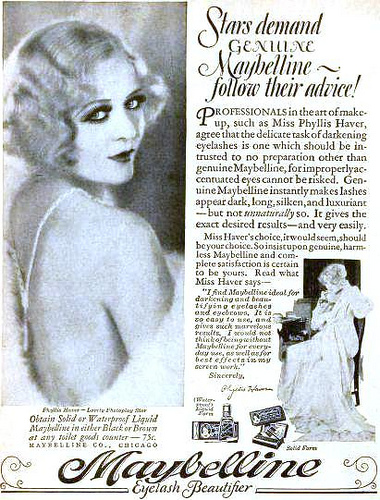
Historically, women darkened their lashes with everything from elderberries to resin, but mascara Products did not emerge until the 20th century when T.L. Williams founded Maybelline. The brand’s popular 10-cent mascara swept the nation. While makeup had once been considered immoral by some, Hollywood  actress’s made it glamorous. Women were promised the sultry eyelash’s of there favorite actress, as in this advertisement from a 1929 “Motion Picture” magazine:

realhairtruth.com

As more mascara products emerged, companies began making numerous claims about the lengthening and volumizing effects of their products. Major cosmetic companies have come under fire for misleading advertising methods, like using false eyelash’s on models.

Even so, the quest for longer lashes has grown into a full-fledged beauty and pharmaceutical market.  “Five years ago, the lashes you had were the lashes you had and you threw mascara on. Today, you’re getting extensions, your eyelashes could always use another millimeter or two, right?

Probeauty (PBA) Would Rather Buy Hair Shows Than To Do What Is Right For The Industry!

Jotovi Designs Inc

The women begin to arrive just before 8 a.m., every day and without fail, until there are thickets of young Asian and Hispanic women on nearly every street corner along the main roads of Flushing, Queens.

As if on cue, cavalcades of battered Ford Econoline vans grumble to the curbs, and the women jump in. It is the start of another workday for legions of New York City’s manicurists, who are hurtled to nail salons across three states. They will not return until late at night, after working 10- to 12-hour shifts, hunched over fingers and toes.

On a morning last May, Jing Ren, a 20-year-old who had recently arrived from China, stood among them for the first time, headed to a job at a salon in a Long Island strip mall. Her hair neat and glasses perpetually askew, she clutched her lunch and a packet of nail tools that manicurists must bring from job to job.

Tucked in her pocket was $100 in carefully folded bills for another expense: the fee the salon owner charges each new employee for her job. The deal was the same as it is for beginning manicurists in almost any salon in the New York area. She would work for no wages, subsisting on meager tips, until her boss decided she was skillful enough to merit a wage.

It would take nearly three months before her boss paid her. Thirty dollars a day.

Once an indulgence reserved for special occasions, manicures have become a grooming staple for women across the economic spectrum. There are now more than 17,000 nail salons in the United States, according to census data. The number of salons in New York City alone has more than tripled over a decade and a half to nearly 2,000 in 2012.

Real Hair Truth.com

But largely overlooked is the rampant exploitation of those who toil in the industry. The New York Times interviewed more than 150 nail salon workers and owners, in four languages, and found that a vast majority of workers are paid below minimum wage; sometimes they are not even paid. Workers endure all manner of humiliation, including having their tips docked as punishment for minor transgressions, constant video monitoring by owners, even physical abuse. Employers are rarely punished for labor and other violations.

Asian-language newspapers are rife with classified ads listing manicurist jobs paying so little the daily wage can at first glance appear to be a typo. Ads in Chinese in both Sing Tao Daily and World Journal for NYC Nail Spa, a second-story salon on the Upper West Side of Manhattan, advertised a starting wage of $10 a day. The rate was confirmed by several workers.

Lawsuits filed in New York courts allege a long list of abuses: the salon in East Northport, N.Y., where workers said they were paid just $1.50 an hour during a 66-hour workweek; the Harlem salon that manicurists said charged them for drinking the water, yet on slow days paid them nothing at all; the minichain of Long Island salons whose workers said they were not only underpaid but also kicked as they sat on pedicure stools, and verbally abused.

Last year, the New York State Labor Department, in conjunction with several other agencies, conducted its first nail salon sweep ever — about a month after The Times sent officials there an inquiry regarding their enforcement record with the industry. Investigators inspected 29 salons and found 116 wage violations.

Among the more than 100 workers interviewed by The Times, only about a quarter said they were paid an amount that was the equivalent of New York State’s minimum hourly wage. All but three workers, however, had wages withheld in other ways that would be considered illegal, such as never getting overtime.

The juxtapositions in nail salon workers’ lives can be jarring. Many spend their days holding hands with women of unimaginable affluence, at salons on Madison Avenue and in Greenwich, Conn. Away from the manicure tables they crash in flophouses packed with bunk beds, or in fetid apartments shared by as many as a dozen strangers.

Ms. Ren worked at Bee Nails, a chandelier-spangled salon in Hicksville, N.Y., where leather pedicure chairs are equipped with iPads on articulated arms so patrons can scroll the screens without smudging their manicures. They rarely spoke more than a few words to Ms. Ren, who, like most manicurists, wore a fake name chosen by a supervisor on a tag pinned to her chest. She was “Sherry.” She worked in silence, sloughing off calluses from customers’ feet or clipping dead skin from around their fingernail beds.

At night she returned to sleep jammed in a one-bedroom apartment in Flushing with her cousin, her cousin’s father and three strangers. Beds crowded the living room, each cordoned off by shower curtains hung from the ceiling. When lights flicked on in the kitchen, cockroaches skittered across the counter-tops.

Almost all of the workers interviewed by The Times, like Ms. Ren, had limited English; many are in the country illegally. The combination leaves them vulnerable.

Some workers suffer more acutely. Nail salons are governed by their own rituals and mores, a hidden world behind the glass exteriors and cute corner shops. In it, a rigid racial and ethnic caste system reigns in modern-day New York City, dictating not only pay but also how workers are treated.

Korean workers routinely earn twice as much as their peers, valued above others by the Korean owners who dominate the industry and who are often shockingly plain-spoken in their disparagement of workers of other backgrounds. Chinese workers occupy the next rung in the hierarchy; Hispanics and other non-Asians are at the bottom.

The typical cost of a manicure in the city helps explain the abysmal pay. A survey of more than 105 Manhattan salons by The Times found an average price of about $10.50. The countrywide average is almost double that, according to a 2014 survey by Nails Magazine, an industry publication.

With fees so low, someone must inevitably pay the price.

“You can be assured, if you go to a place with rock-bottom prices, that chances are the workers’ wages are being stolen,” said Nicole Hallett, a lecturer at Yale Law School who has worked on wage theft cases in salons. “The costs are borne by the low-wage workers who are doing your nails.”

Until more people realize that a $10.50 manicure or a $6.00 tee shirt cannot be the means to earn a living wage for its producer (just do the math)….I doubt this exploitation will end.

In interviews, some owners readily acknowledged how little they paid their workers. Ms. Ren’s boss, Lian Sheng Sun, who goes by Howard, at first denied doing anything wrong, but then said it was just how business was done. “Salons have different ways of conducting their business,” he said. “We run our business our own way to keep our small business surviving.”

Many owners said they were helping new immigrants by giving them jobs.

“I want to change the first generation coming here and getting disgraced, and getting humiliated,” said Roger Liu, 28, an immigrant from China, seated inside the salon he owned, Relaxing Town Nails and Spa in Huntington Station, N.Y. As he spoke last summer, an employee, a woman in her 50s, paced the salon, studying a scrap of paper scribbled with the steps of a pedicure, chanting them to herself quietly in Chinese.

It was her first week working in a salon, she said. Mr. Liu was not paying her.

More to come Next week on This Story!
Loreal Always In Trouble

logos-loreal

FEB 12, 2015

WARNING LETTER

VIA OVERNIGHT DELIVERY
Brigitte Liberman, President Active Cosmetics Division
L’Oréal USA
575 Fifth Avenue
New York, NY 10017
Re: CMS # 440851
Dear Ms. Brigitte Liberman:
This letter is to advise you that the Food and Drug Administration (FDA) reviewed your website at the Internet address http://www.laroche-posay.us in December 2014. Based on this review, you take orders there for your products “Rosalic AR Intense” and “Mela-D Pigment Control,”  which appear to be promoted for uses that cause the products to be drugs under section 201(g)(1)(C) of the Federal Food, Drug, and Cosmetic Act (the Act) [21 U.S.C. § 321(g)(1)(C)]. The claims on your website indicate that the products are intended for use in the cure, mitigation, treatment, or prevention of disease and/or are intended to affect the structure or any function of the human body, rendering them drugs under the Act. As explained further below, introducing or delivering these products for introduction into interstate commerce for such uses violates the Act.
Examples of some of the claims on the website http://www.laroche-posay.us, that provide evidence that your products are intended for use as drugs include:
Rosaliac AR Intense:
  • “Localized Redness Intensive Serum”
  •  “RECOMMENDED FOR: Redness-prone skin, experiencing overall redness, flushing and sensations of discomfort”
  •  “Reduces visible redness and sensations of discomfort”
  • “[F]ormula combining 3 effective ingredients to help reduce redness with a long lasting efficacy”
  • “I have rosaceaon my neck when I get warm or under stress. This product really works to keep it under control!!!”
  • “I have broken capillaries and generalized redness on several areas of my face. I was told laser treatment was the only fix. Then…the miracle of Rosalic AR!”
  • “With powerful Ambophenol [0.5%] to visibly reduce redness”
Mela-D Pigment Control:
  • “Concentrated Dark Spot Correcting Serum”
  • “Use to treat dark spots and discolorations”
  • “Recommended For: Hyperpigmentation and Dark Spots”
  • “With 2% Kojic Acid to visibly reduce the intensity of dark spots”
Your “Rosalic AR Intense” and “Mela-D Pigment Control” products are not generally recognized as safe and effective for the above-referenced uses and, therefore, these products are “new drugs” under section 201(p) of the Act [21 U.S.C. § 321(p)]. New drugs may not be legally introduced or delivered for introduction into interstate commerce without prior approval from FDA, as described in section 505(a) of the Act [21 U.S.C. § 355(a)]; see also section 301(d) of the Act [21 U.S.C. § 331(d)]. FDA approves a new drug on the basis of scientific data submitted by a drug sponsor to demonstrate that the drug is safe and effective. A description of the new drug approval process can be found on FDA’s internet website at http://www.fda.gov/Drugs/DevelopmentApprovalProcess/HowDrugsareDevelopedandApproved/ApprovalApplications/NewDrugApplicationNDA/default.htm. Any questions you may have regarding this process should be directed to the Food and Drug Administration, Division of Drug Information, Center for Drug Evaluation and Research, 10903 New Hampshire Avenue, Silver Spring, Maryland 20993.
Furthermore, your “Rosaliac AR Intense” product is offered for conditions that are not amenable to self-diagnosis and treatment by individuals who are not medical practitioners; therefore, adequate directions for use cannot be written so that a layperson can use this drug safely for its intended purposes. Thus, this drug is misbranded within the meaning of section 502(f)(1) of the Act, in that its labeling fails to bear adequate directions for use [21 U.S.C. § 352(f)(1)]. The introduction of a misbranded drug into interstate commerce is a violation of section 301(a) of the Act [21 U.S.C. § 331(a)].
The Real HAIR TRUTH
This letter is not an all-inclusive statement of violations associated with your products or their labeling, and we have not attempted to list here all of the products that are promoted on your website for intended uses that cause them to be drugs. It is your responsibility to ensure that all products marketed by your firm comply with the Act and its implementing regulations. We advise you to review your website, product labels, and other labeling for your products to ensure that the claims you make for your products do not reflect intended uses that cause the distribution of the products to violate the Act.
We request that you take prompt action to correct the violations cited in this letter. If you do not believe that your products are in violation of the Act, include your reasoning and any supporting information for our consideration. Failure to promptly correct these violations may result in legal action without further notice, including, without limitation, seizure and/or injunction.
Please notify this office in writing within fifteen (15) working days of the receipt of this letter as to the specific steps you have taken to correct the stated violations, including an explanation of each step being taken to identify violations and make corrections to ensure that similar violations will not recur. If you do not believe that your products are in violation of the Act, include your reasoning and any supporting information for our consideration. If the corrective action cannot be completed within fifteen working days, state the reason for the delay and the time frame within which the corrections will be implemented.
THE REAL HAIR TRUTH
You should direct your written reply to Dehlia Young, Compliance Officer, Division of Enforcement (HFS-608), Office of Compliance, Center for Food Safety and Applied Nutrition, 5100 Paint Branch Pkwy, College Park, MD 20740. If you have any questions regarding this letter, you may contact Ms. Young via email at dehlia.young@fda.hhs.gov.
Sincerely,
/S/
William A. Correll
Director
Office of Compliance
Center for Food Safety
     and Applied Nutrition

In The Beauty Industry The Scum Always Rises To The Top

The Real Hair Truth.com

U.S. Department of Education Takes Enforcement Against Two School Ownership Groups!

Office of Federal Student Aid issues letters denying re certification applications for Title IV eligibility to several Marinello Schools of Beauty and Computer Systems Institute locations
February 1, 2016
As part of the Obama Administration’s ongoing commitment to protect students and increase accountability and transparency in higher education, the U.S. Department of Education is taking action to end the participation in the federal student financial assistance programs of 23 Marinello Schools of Beauty (Marinello) campuses in Nevada and California and three Computer Systems Institute (CSI) campuses in Illinois.

Investigations by the Department’s Office of Federal Student Aid (FSA) uncovered serious violations within both institutions. The Department determined that CSI submitted false job placement rates to its students, the Department, and its national ac-creditor, the Accrediting Council for Independent Colleges and Schools (ACICS). The Department determined that Marinello was knowingly requesting Federal aid for students based on invalid high school diplomas, under awarding Title IV aid to students, charging students for excessive overtime, and engaging in other acts of misrepresentation.

“Our students depend on higher education institutions to prepare them for careers through a quality education. Unfortunately, some schools violate their trust through deceptive marketing practices and defraud taxpayers by giving out student aid inappropriately. These unscrupulous institutions use questionable business practices or outright lie to both students and the federal government,” said Under Secretary Ted Mitchell. “In these cases we are taking aggressive action to protect students and taxpayers from further harm by these institutions.”

The Department is denying pending recertification applications for five Marinello locations covering 23 campuses in five cities and enrolling about 2,100 active students.

The campuses are:

  • Las Vegas, Nevada (2 Locations; 209 active students)
  • Los Angeles, California (14 locations; 1,277 active students)
  • Burbank, California (2 locations; 255 active students)
  • Moreno Valley, California (2 locations; 115 active students)
  • Sacramento, California (3 locations; 244 active students)

In addition, the Department previously placed all Marinello schools on Heightened Cash Monitoring 2, which is a step taken by FSA to provide additional oversight of institutions to safeguard taxpayer dollars.

The Department is also denying a pending re certification application from CSI, which enrolls about 2,600 active students.

The letters to the Marinello schools and CSI provide an opportunity for the institutions to submit factual evidence to dispute the Department’s findings. The Marinello schools have until February 16, 2016, to submit such evidence; CSI has until February 12, 2016, to do so. If submitted evidence causes the Department to change its determination, the schools could be able to continue participating in the federal financial aid programs.

The entire Marinello school chain – with 56 campuses across the nation – received more than $87 million in Pell Grants and federal loans for the 2014–15 award year.

Collectively, CSI campuses received approximately $20 million in federal funding for the 2014-15 award year.

For more information about today’s action, please visit StudentAid.gov/sa/about/announcements/marinello and StudentAid.gov/sa/about/announcements/csi.

“Your skin is too dark.” 1950’s Racial Advertising

realhairtruth.com


In America, the perennial quest for beauty is an expensive one.

Every year, women spend billions of dollars in exchange for beautiful hair, luxurious eye lashes, and smooth, silky skin. Still, many of our culture’s most common beauty procedures were virtually nonexistent a century ago. The truth is, many of our expectations of feminine beauty were shaped in large part by modern advertisers. We’ve tracked the history behind some of the most common “flaws” that besiege the modern woman and the surprising stories behind their “cures.”

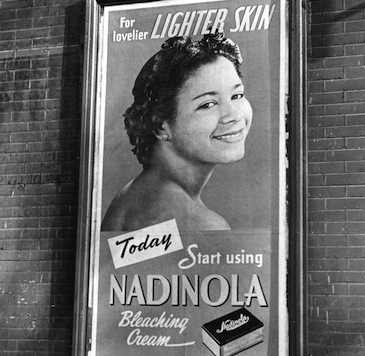
During the late-19th century and early-20th century, skin lightening became popular with black women. Skin bleaching was seen as more than a beauty ritual — it was a symbolic way to progress in a prejudiced society, where lighter-skinned black people encountered comparatively better treatment. Advertisers exploited those prejudices in the beauty industry, promising women that they could “occupy more positions socially and commercially” marry better, “get along better” and be more beautiful with lighter skin. In this 1944 ad, lighter skin is equated with “lovelier” skin:

Advertisement for Nadinola bleaching cream, 'for lovelier lighter skin,' New York, New York, 1944. (Photo by Fred Stein Archive/Archive Photos/Getty Images)

The actual products were seriously dangerous: Most contained the chemical hydroquinone which is also used to develop photographs. (The chemical has been banned in Australia, the EU, and Japan, but remains legal in the United States)

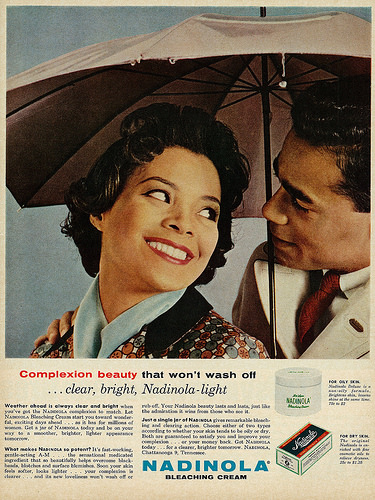
During the ’60s and ’70s, the skin marketing popularity dipped in the 1970’s as the “Black is Beautiful” movement grew. The movement encouraged black people to embrace their natural features, rather than attempt to conform to white beauty norms. Cosmetic companies quickly softened their rhetoric, and the phrase “skin lightening” was changed to the somewhat more innocuous term “skin brightening.” The smiling 1962 ad below promises bright, light skin even on the rainiest day while neglecting to mention the possible side effect of mercury poisoning.  Today, skin lightening continues to be practiced around the world, with particular popularity in Africa, India and Pakistan. The annual global market is expected to reach $10 billion by 2016, though many of the products come with serious health risks.