“Your skin is too dark.” 1950’s Racial Advertising

realhairtruth.com


In America, the perennial quest for beauty is an expensive one.

Every year, women spend billions of dollars in exchange for beautiful hair, luxurious eye lashes, and smooth, silky skin. Still, many of our culture’s most common beauty procedures were virtually nonexistent a century ago. The truth is, many of our expectations of feminine beauty were shaped in large part by modern advertisers. We’ve tracked the history behind some of the most common “flaws” that besiege the modern woman and the surprising stories behind their “cures.”

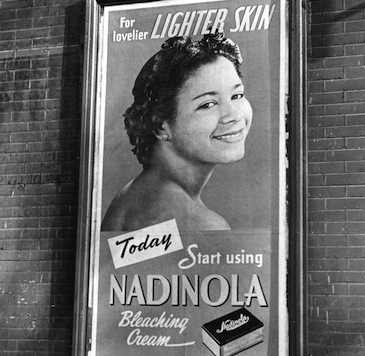
During the late-19th century and early-20th century, skin lightening became popular with black women. Skin bleaching was seen as more than a beauty ritual — it was a symbolic way to progress in a prejudiced society, where lighter-skinned black people encountered comparatively better treatment. Advertisers exploited those prejudices in the beauty industry, promising women that they could “occupy more positions socially and commercially” marry better, “get along better” and be more beautiful with lighter skin. In this 1944 ad, lighter skin is equated with “lovelier” skin:

Advertisement for Nadinola bleaching cream, 'for lovelier lighter skin,' New York, New York, 1944. (Photo by Fred Stein Archive/Archive Photos/Getty Images)

The actual products were seriously dangerous: Most contained the chemical hydroquinone which is also used to develop photographs. (The chemical has been banned in Australia, the EU, and Japan, but remains legal in the United States)

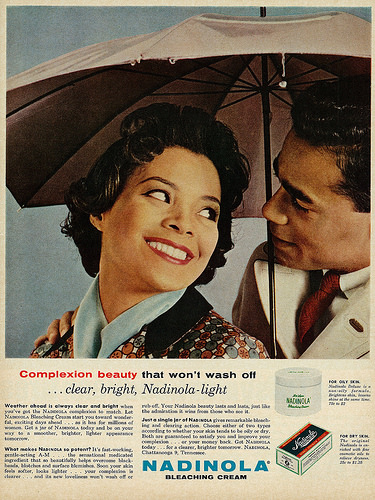
During the ’60s and ’70s, the skin marketing popularity dipped in the 1970’s as the “Black is Beautiful” movement grew. The movement encouraged black people to embrace their natural features, rather than attempt to conform to white beauty norms. Cosmetic companies quickly softened their rhetoric, and the phrase “skin lightening” was changed to the somewhat more innocuous term “skin brightening.” The smiling 1962 ad below promises bright, light skin even on the rainiest day while neglecting to mention the possible side effect of mercury poisoning.  Today, skin lightening continues to be practiced around the world, with particular popularity in Africa, India and Pakistan. The annual global market is expected to reach $10 billion by 2016, though many of the products come with serious health risks.

7 Ways The Beauty Industry Convinced Women That They Weren’t Good Enough

Jotovi Designs Inc

In America, the perennial quest for beauty is an expensive one.

Every year, women spend billions of dollars in exchange for beautiful hair, lovely lashes, and smooth and silky skin. Still, many of our culture’s most common beauty procedures were virtually nonexistent a century ago. The truth is, many of our expectations of feminine beauty were shaped in large part by modern advertisers. We’ve tracked the history behind some of the most common “flaws” that besiege the modern woman and the surprising stories behind their “cures.”

1. “Your natural hair color isn’t pretty enough.”

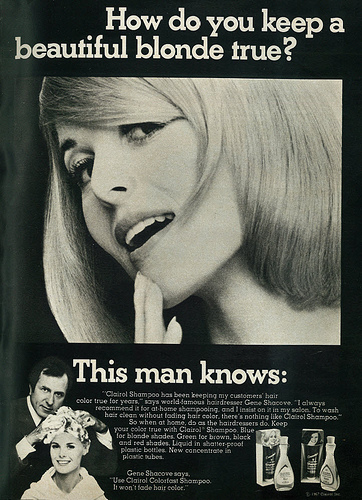
“Does she or doesn’t she?” asked the Clairol’s ad that launched a million home hair dye jobs. Indeed, the aggressive Clairol Marketing would trigger an explosion in sales. In the process, the percentage of women dyeing their hair would skyrocket from 7 percent to more than 40 percent in the ’70s.

The ads showed everyday women reaping the benefits of more lustrous hair, a luxury that had long been exclusive to glamorous supermodels with professional dye jobs. The ads proclaimed, “If I have only one life, let me live it as a blonde.” Indeed, Clairol peddled the perfect yellow shade of the dye as a way to transform your life:

realhairtruth.com

Clairol hair dye offered self reinvention, in 20 minutes flat, particularly for women who didn’t want to reveal their true age or grey roots.

realhairtruth.com

Shirley Polykoff, the advertising writer behind Clairol’s goldmine campaign, described her plan as such: “For big success, we’d have to expand the market to gather in all those ladies who had become stoically resigned to [their gray hair]. This could only be accomplished by reawakening whatever dissatisfaction’s they may have had when they first spotted it.” Clairol did that with ads like, “How long has it been since your husband asked you out to dinner?” Nowadays, about 90 million women in the U.S. color their hair.


Chaz Dean Is In Trouble!

xwvrRwa

A celebrity hairstylist is at the center of a lawsuit involving people from all over the country who have come forward to claim that his hair-care products have caused them scalp irritation, hair loss and more.  Tanya Norman, who also specializes in brand development for a creative agency, is one of these people. Six months after trying the WEN hair product, Norman says she was alarmed at what happened.  “I had started to get a bald spot, and then I found another one in the back, and that’s when I kind of started to get worried,” Norman said. “I started bawling. I couldn’t stop crying.”  Now, attorney Amy Davis is representing nearly 200 plaintiffs from over 40 different states who are part of a mass-action lawsuit against WEN by Chaz Dean Inc.

“Some of the men and women that we represented, looks like they had a weed whacker taken to their head,” Davis described. “Just hair breaking all over.”  Dean, who developed the WEN hair-product line, has a hair-care studio in Hollywood, and celebrities such as Brooke Shields, Angie Harmon.  Davis, however, states that the product traps dirt, oil and debris in the hair follicle and causes scalp irritation.   Davis went on to claim that the celebrity endorsements made women, men and even children believe in the product.  “Their testimonials and Mr. Dean saying that he is the stylist to the who’s-who in Hollywood really made these men and women believe they could trust the product,” Davis said. “Kiddos, kiddos that we represent, have lost nearly all of their hair.”

While  Mr. Dean declined to be interviewed on camera, they released a statement that reads:

“We take great pride in the quality of our products and believe every product meets our high standards. We want all of our customers to have positive experiences with our products. With well over 10 million WEN products shipped since 2008, our customers’ overwhelmingly positive response to WEN is a testament to there benefits it can deliver for its users. These benefits are reflected in consistently high rankings from independent consumer product sites as well. Importantly, there is no scientific evidence to support any claim that our hair care products caused anyone to lose their hair. There are many reasons why individuals may lose their hair, all unrelated to WEN hair products. We intend to vigorously contest the allegations made against our products. And, we encourage any customer with any questions to contact us.”  Norman, meanwhile, now applies a topical medicine and has received 14 cortisone injections in her bald spots. She says that despite her embarrassment, she believes going public with her experience may help others.

wen-by-chaz-dean_featured

“The hair that’s regrowing is very, very fine and brittle. This is something that for me has been very, very embarrassing,” Norman said. “There are a lot of us out there that have been dealing with this issue. You’re not alone.”

The federal judge has issued a stay in the case, and the parties are proceeding to mediation.


Retail Regulation In The Cosmetic Industry

real hair truth
The $71 billion personal care product industry in the United States is largely unregulated, and retailers are stepping up to fill the void.

When retailers adopt policies on the safety of the products they sell, it’s called retail regulation.

There is a rich history of retailers using their purchasing power to effect positive market change.
In 2008, when Walmart—the world’s largest retailer—agreed to stop selling baby bottles, sippy cups and sports water bottles made with BPA, it forced manufacturers to reformulate in order to keep selling to this retail giant.
More and more retailers are adopting store wide policies governing the safety of their beauty products, with Whole Foods leading the way by implementing a basic chemical safety screening for all its personal care products and adopting a restricted-substances list made up of more than 400 chemicals prohibited from products bearing its premium standards labels.
In 2008 CVS stepped up to the plate by adopting a store-wide policy prohibiting the use of certain
toxic chemicals in their store-brand baby products. Walgreen’s and Target followed suit in 2013 by
announcing they would develop and adopt comprehensive cosmetic safety policies to govern the
safety of the private-label and national brands they carry.
The following goals should guide retailers’ policies and practices to improve the safety of personal
care products sold in their stores:
Expand the sale of safer cosmetics and personal care products (products free of chemicals
linked to cancer, birth defects, developmental harm and other health concerns).
Adopt a list of chemicals that are banned from use in private-label and national brands sold
in their stores, and ensure that toxic chemicals are replaced with safer alternatives.
Reformulate private-label products to eliminate chemicals of concern.
Practice the highest level of transparency by sharing the company’s safe-cosmetics policy,
practices and progress on websites and in corporate responsibility reports.
Strive for continuous improvements in policies and practices by monitoring scientific
research regarding emerging chemicals of concern.
Federal Regulations
Major loopholes in federal law allow the cosmetics industry to put virtually any chemical into a
cosmetic or personal care product with no pre-market FDA safety testing or review, no monitoring
of health effects, and inadequate labeling requirements. Most of us assume the FDA regulates
these products just as it does food and drugs to assure safety. In fact, cosmetics are one of the least
regulated consumer products available to the public. To make matters worse, contaminants in a
finished cosmetic product that occur as by-products of the manufacturing process, by law, don’t
have to be listed on the product label. That means chemicals like PFOA can hide in a cosmetic or
personal care product without consumers knowing.
The Federal Food, Drug and Cosmetics Act (FFDCA) includes 112 pages of standards for food and
drugs, but just a single page for cosmetics. The cosmetics title of the FFDCA, which has not been
amended significantly since it was enacted more than 77 years ago, provides virtually no power to
perform even the most rudimentary functions to ensure product safety in an estimated $71 billion
cosmetic industry.
Fortunately, for the first time in 77 years, Congress could close the gaping holes in our outdated
federal law and give the FDA the statutory authority and resources it needs to effectively regulate
the safety of cosmetics and personal care products. Currently, Congress is considering two bills to
regulate cosmetics ingredients.
The Senate
On April 20, 2015, Senators Dianne Feinstein (D-CA) and Susan Collins (R-ME) introduced the
Personal Care Products Safety Act of 2015, an important bill with the potential to give the cosmetics
industry a desperately needed makeover. Many strong provisions in the bill would advance the
FDA’s ability to protect consumers from unsafe chemicals in cosmetics and personal care products:
Requiring companies to register their facilities, products and ingredients with the FDA;
Closing labeling loopholes by requiring full ingredient disclosure for professional salon
products and web-based sales of cosmetic products; and
Directing the FDA to assess the safety of a minimum of five cosmetics chemicals a year.
However, the bill falls short of what is needed. Ideally, federal regulation would put in place a robust
safety standard and elevate the rigor of ingredient safety reviews by the FDA and manufacturers to
ensure that cosmetics and personal care products are as safe as possible
Sulfate Free Shampoo Is “A Marketing Gimmick.”

real hair truthSulfate-free shampoo is a new form to trying to get people’s attention, “a marketing gimmick.” The hair industry is a billion dollar business. . Example: Green tea is the new trend and it is healthier for you, or buying coffee at Starbucks, they taste sweeter. More profits for them. BK’s green tea had been recalled, or the eggs, is that mean people won’t be buying green tea or eggs anymore? The hair industry wants your attention, but they don’t give money back guarantee for damaged hair or hair loss.

It would be boring if they just call it shampoo! Google shampoo, it’s meant to clean. They want a variety of product, to attract a variety of hair textures/condition/smell.

There are sulfates in many of the everyday products we use at home! Sulfates on shampoo doesn’t cause cancer. But Google hair dyes & cancer. Many customers and stylists do not know that Brazilian treatment often contains high concentrations of formaldehyde, a cancer-causing chemical and there’s been so much publicity during the last year. Google Permanently straightening hair warning, about 7,410,000 results (0.08 seconds) , more warnings during the last month. I’ve been posting about them since 2009. Canada had issued a public health warning regarding Brazilian Blowout and has stopped the distribution of their salon products; Ireland has also issued a recall. ~ Also published in Vogue Feb. 2011.

How about Mane & tail people think it makes their hair grow faster. Mane & Tail is another shampoo meant for horses. Horses don’t abuse their hair, using heating tools, and they eat better than people, but it won’t add more hair & make their hair longer faster. Shampoo intended for animals may contain insecticides or other medications for treatment of skin conditions or parasite infestations such as fleas or mange. These must never be used on humans.

When you wash your hair with one of those nutrient-rich shampoos, most of the nutrients and active ingredients in the product don’t actually end up in your hair, they wind up down the drain… along with all the money you spent on the shampoo.
It is HOW you use to style your hair or what styling tools that damage the hair, and what chemicals you’re adding to the hair, not the shampoo.

So what can you expect from switching to a sulfate-free shampoo? A higher price tag, to start, as most drug store brands don’t yet produce products without sulfates.  Perhaps the biggest adjustment to using sulfate-free shampoo is a superficial one. Without this lather-producing chemical, these shampoos have less of the over-the-top bubble that is associated with cleansing hair.  Its all a bunch of baloney!

FYI: “CRUELTY FREE” OR “NOT TESTED IN ANIMALS” MEANS THAT NO ANIMAL TESTING WAS DONE ON THE PRODUCT AND ITS INGREDIENTS.
Believe it or not
Even if a product never was tested in animals, there’s a very good chance its ingredients were. A company might call its products “cruelty free” because it isn’t doing any animal testing on these ingredients now, although the ingredients may have been tested on animals in the past. In some cases, “no new animal testing” might be a more accurate claim.