Hair Salon Owners Sent to Jail for Payroll Tax Fraud

Joseph and Vidal


A husband and wife who owned and operated hair salons in Southern California were sentenced to prison for failing to pay payroll taxes.

John D. Pham and Annya A. Nguyen, both of Laguna Niguel, operated hair salons under the Fantastic Sams name at various times since 1985 in the cities of Orange, Laguna Niguel, Aliso Viejo, and Rancho Santa Margarita.

On Oct. 1, Pham was sentenced to serve 37 months in prison and three years of supervised release. He had previously pleaded guilty to a charge that he had willfully failed to account for and pay income and Social Security taxes withheld from the wages of employees of one of the corporations involved in the scheme. He admitted that he and his wife had incorporated 10 companies, all of which had failed to pay payroll taxes from 1996 through 2004.

On Sept. 4, Nguyen was sentenced to serve five months in prison and three years of supervised release. She previously had pleaded guilty to a charge that she had conspired with Pham to defraud the United States by impeding the Internal Revenue Service in the collection of taxes. She admitted that the conspiracy spanned a period of at least eight years and involved a loss to the government of over $770,000 of payroll taxes. Nguyen also admitted that she failed to pay more than $80,000 of her federal income tax liabilities during the same time period.

Nguyen and Pham were also accused of diverting assets from some of the corporations they controlled to their own personal benefit.  Both were ordered to jointly pay restitution of $629,105 to the IRS.

Chris Rock’s “Good Hair” Opens Eyes to African-American Beauty Culture

Joseph Kellner

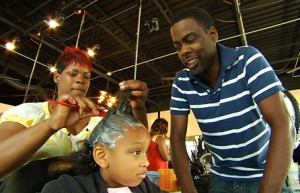
When Chris Rock’s daughter, Lola, came to him crying and asked, “Daddy, how come I don’t have good hair?” the bewildered comic committed himself to figuring out the complex answer to his daughter’s simple, but profound question.

In the documentary film, Good Hair, Rock takes us on a fascinating journey through the international business trade of hair weaves, the science behind relaxers and the surprising question of how much black women spend on their hair.

During a press junket for a film festival in Salt Lake City, Rock discussed with Salon Magazine journalist Andrew O’Hehir how the initial idea for the film expanded the further he investigated.

“It kind of blew my mind, the idea that in an African-American household you got this Porsche that nobody can see, these working-class and middle-class black women spending thousands of dollars… buying a Porsche that nobody sees.” He adds, “There is a whole economic realm to this that I didn’t know about at all.”

 Human hair is India’s single largest export. He also sees how the culture has adapted to make harvesting the hair easy and profitable for the industry. Many Hindu temples conduct “hair sacrifices” during religious ceremonies that allow members of the temple a few moments of cultural distinction (and no money) in exchange for hair that can later be worth thousands of dollars. This “sacrificed” hair is processed and sold to hair dealers around the world who, in turn, sell it to local dealers who, in turn, sell it to salons and hair vendors at a huge profit.

How does Rock view this suspicious economic angle? He tells O’Hehir a different cut of the movie exists where Rock treats the hair trade as a problem for black females. He later calls on women to reject this international cartel of exploitation. But, he says, in the end that version simply wasn’t as fun to watch. He said he would rather inform and entertain rather than divide and mobilize.

On that tip, Rock succeeds. The movie is a serious, yet non-confrontational look at how cultural norms can make us do and believe some crazy things. It’s entertaining, but not angry. Celebrities such as Ice-T, Nia Long, Paul Mooney, Raven Symoné, Maya Angelou, and Reverend Al Sharpton all candidly offer their stories and observations that add much more entertainment to what could have become a sobering, but impersonal look into the culture of beauty in the world.

A BIG CHANGE IS COMING TO OUR INDUSTRY!


Josephkellner.com


Keri Gorder, until recently the manager of a hair salon in Great Falls, Mont., said she was surprised last month by a document that her company wanted stylists to sign.

Ms. Gorder said the salon’s parent company, the Regis Corporation, had urged the four stylists at her salon, Cost Cutters, to sign a document that would seemingly nullify any future support they showed for unionization.

Labor leaders in Montana accuse the company of seeking to take away the stylists’ right to form a union. But Regis says the document merely seeks to ensure that workers choose unions through a secret-ballot election — at a time when unions are pushing legislation in Congress that would make it easy to bypass secret ballots.

The document the stylists at several Montana salons were urged to sign said they were agreeing to revoke any future signature they put on a pro-union card that could be counted as showing support for unionizing.

“I thought it was taking our right away before we ever exercised that right,” Ms. Gorder said.

She said her area supervisor had pressured the stylists to sign the cards. “The area supervisor said, ‘I would do what the company wants you to do,’ ” Ms. Gorder said, adding that she quit her job this month because of her dismay over the situation.

Soon she informed labor leaders about the document, and now they are threatening to picket the salon and hand out pro-union fliers.

“It’s the craziest thing I’ve ever seen,” said Ole Stimac, president of the Central Montana Central Labor Council. “I’ve never seen anything where you sign away your rights for eternity to unionize.”

Regis executives said they had distributed the document out of concern that Congress would enact legislation backed by labor that would require employers to recognize a union as soon as a majority of workers signed pro-union cards, without holding a secret-ballot election.

Paul Finkelstein, chief executive at Regis, the nation’s largest hair salon company, said many employees signed such pro-union cards without understanding that it could commit them to joining a union. Mr. Finkelstein said the company’s focus groups showed that employees overwhelmingly favored using secret ballots to decide whether to join a union.

The document the hair stylists were asked to sign, titled Protection of Secret Vote Agreement, said, “In order to preserve my right to a secret-ballot election, and for my own protection, I knowingly and without restraint and free from coercion sign this agreement revoking and nullifying any union authorization card I may execute in the future.”

Mr. Finkelstein said the document was intended to ensure that the employees’ cards were never counted to show majority support for a union — in case Congress someday enacted the union-card legislation.

“The sole issue is that our people want to use a secret ballot,” he said, asserting that union organizers often manipulate workers into signing pro-union cards, known as authorization cards.

Mr. Finkelstein added: “We’re not threatening people, ‘You’d better sign.’ It’s totally voluntary.”

William B. Gould IV, a Stanford law professor and former chairman of the National Labor Relations Board, said, “It seems like a modernized version of the old yellow dog contract,” a provision, now illegal, that many employers used to push workers to sign, pledging not to join a union as a condition of employment.

Assessing the salon document, Mr. Gould said, “I think it’s illegal because an authorization card is the principal vehicle unions use to organize the unorganized.”

Under current law, at least 30 percent of a workplace’s employees must sign cards to lead to a secret-ballot election. Mr. Gould said that under the Regis document, cards signed to seek a secret ballot would automatically be revoked.
Salon Advice For Great Customer Service!

Salon Advice For Great Customer Service!!!

There are many books and articles out there that tell us that sales people need to listen more. If you do an Internet search on the word combination “developing listening skills” Google will spit back at you more than 2 million web references. Most of that material pretty much tells us the same thing: Use active listening, nod your head to show that you are listening, repeat back what you heard, ask clarifying questions, listen to understand, listen with your eyes, etc.

However, much of what we call “listening” actually deals with where our attention is focused and understanding the information that we receive. Realize that your client is always communicating something to you. It’s up to you as a sales person to take in as much information as possible, understand what is being communicated, interpret it in the appropriate context, and then use it to provide a suitable solution.
1. Listen to the speed and cadence of your prospect’s speech patterns.
There are gross generalizations that we can apply here, such as people that talk fast are from the Northeast while those that talk at a slower pace are from the South. These types of gross generalizations are just that, gross, and they will get you into trouble.

Remember that you want to communicate effectively with your client, not to look for generalizations to make your life easier. And you communicate most effectively with your clients when you talk like them. When you speak, match their speed and cadence. If you insist on talking at a fast pace because you were told that talking fast conveys excitement, then you are missing an opportunity with the prospect that associates a slower pace with trust and certainty.

Typically, when sales people speak with no regard for how their client is speaking, the result is that neither one communicates as effectively as possible. If you want to achieve rapport and communicate as effectively as possible, then exercise your flexibility and talk like your prospect. When you introduce yourself or when you ask questions, listen to the cadence of your prospect’s voice and then talk at their rate in order to initiate and sustain the communication process.

Joseph Kellner Booth Rental Advice

josephkellner.com
josephkellner.com

As a booth renter the owner of the salon has no say as to how you run your business. The salon owner is mostly a landlord and you are the tenant. They should not provide you with phone, towels, products, training or tools, these should all be paid for and provided by yourself. Any repairs or improvements to your area or the salon are negotiable.

If your problem is with walk-ins, many salons do not allow renters to take any salon walk-ins at all. You are responsible for your own advertizing and furnishing your own clients. If you are being treated as an employee, where you are required to answer phones, required to be in the salon specific hours, then you have a problem. First, you should never rent a chair in a salon without having a rental agreement which spells out everything in detail. Get the salons rental agreement BEFORE starting work and sit down with the owner and make sure you understand everything. The major things that should be in any rental agreement are, how much is the rent, when its due and when it can be changed and what exactly is furnished in your rent, how are walk-ins handled, when is the salon available for your use, do you get a key, can you sell your own retail, what services are you allowed to perform, what are your specific cleaning duties. As a booth renter you have certain basic rights. You have the right to schedule your own appointments, determine your own work hours, within the guidelines you agreed upon in your lease and very important, the ability to come and go as you please. You have the right to set your own prices and determine what products you use to perform your services.
www.josephkellner.com
ww.orlandomakeup.com
IFLOOKSCOULDTHRILL.COM