In The Beauty Industry The Scum Always Rises To The Top

The Real Hair Truth.com

U.S. Department of Education Takes Enforcement Against Two School Ownership Groups!

Office of Federal Student Aid issues letters denying re certification applications for Title IV eligibility to several Marinello Schools of Beauty and Computer Systems Institute locations
February 1, 2016
As part of the Obama Administration’s ongoing commitment to protect students and increase accountability and transparency in higher education, the U.S. Department of Education is taking action to end the participation in the federal student financial assistance programs of 23 Marinello Schools of Beauty (Marinello) campuses in Nevada and California and three Computer Systems Institute (CSI) campuses in Illinois.

Investigations by the Department’s Office of Federal Student Aid (FSA) uncovered serious violations within both institutions. The Department determined that CSI submitted false job placement rates to its students, the Department, and its national ac-creditor, the Accrediting Council for Independent Colleges and Schools (ACICS). The Department determined that Marinello was knowingly requesting Federal aid for students based on invalid high school diplomas, under awarding Title IV aid to students, charging students for excessive overtime, and engaging in other acts of misrepresentation.

“Our students depend on higher education institutions to prepare them for careers through a quality education. Unfortunately, some schools violate their trust through deceptive marketing practices and defraud taxpayers by giving out student aid inappropriately. These unscrupulous institutions use questionable business practices or outright lie to both students and the federal government,” said Under Secretary Ted Mitchell. “In these cases we are taking aggressive action to protect students and taxpayers from further harm by these institutions.”

The Department is denying pending recertification applications for five Marinello locations covering 23 campuses in five cities and enrolling about 2,100 active students.

The campuses are:

  • Las Vegas, Nevada (2 Locations; 209 active students)
  • Los Angeles, California (14 locations; 1,277 active students)
  • Burbank, California (2 locations; 255 active students)
  • Moreno Valley, California (2 locations; 115 active students)
  • Sacramento, California (3 locations; 244 active students)

In addition, the Department previously placed all Marinello schools on Heightened Cash Monitoring 2, which is a step taken by FSA to provide additional oversight of institutions to safeguard taxpayer dollars.

The Department is also denying a pending re certification application from CSI, which enrolls about 2,600 active students.

The letters to the Marinello schools and CSI provide an opportunity for the institutions to submit factual evidence to dispute the Department’s findings. The Marinello schools have until February 16, 2016, to submit such evidence; CSI has until February 12, 2016, to do so. If submitted evidence causes the Department to change its determination, the schools could be able to continue participating in the federal financial aid programs.

The entire Marinello school chain – with 56 campuses across the nation – received more than $87 million in Pell Grants and federal loans for the 2014–15 award year.

Collectively, CSI campuses received approximately $20 million in federal funding for the 2014-15 award year.

For more information about today’s action, please visit StudentAid.gov/sa/about/announcements/marinello and StudentAid.gov/sa/about/announcements/csi.
“Your skin is too dark.” 1950’s Racial Advertising

realhairtruth.com


In America, the perennial quest for beauty is an expensive one.

Every year, women spend billions of dollars in exchange for beautiful hair, luxurious eye lashes, and smooth, silky skin. Still, many of our culture’s most common beauty procedures were virtually nonexistent a century ago. The truth is, many of our expectations of feminine beauty were shaped in large part by modern advertisers. We’ve tracked the history behind some of the most common “flaws” that besiege the modern woman and the surprising stories behind their “cures.”

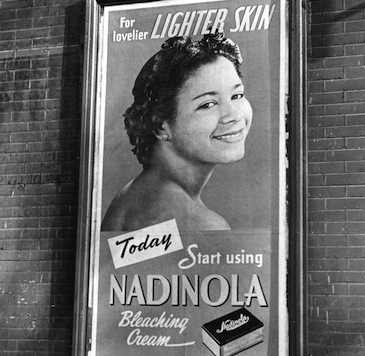
During the late-19th century and early-20th century, skin lightening became popular with black women. Skin bleaching was seen as more than a beauty ritual — it was a symbolic way to progress in a prejudiced society, where lighter-skinned black people encountered comparatively better treatment. Advertisers exploited those prejudices in the beauty industry, promising women that they could “occupy more positions socially and commercially” marry better, “get along better” and be more beautiful with lighter skin. In this 1944 ad, lighter skin is equated with “lovelier” skin:

Advertisement for Nadinola bleaching cream, 'for lovelier lighter skin,' New York, New York, 1944. (Photo by Fred Stein Archive/Archive Photos/Getty Images)

The actual products were seriously dangerous: Most contained the chemical hydroquinone which is also used to develop photographs. (The chemical has been banned in Australia, the EU, and Japan, but remains legal in the United States)

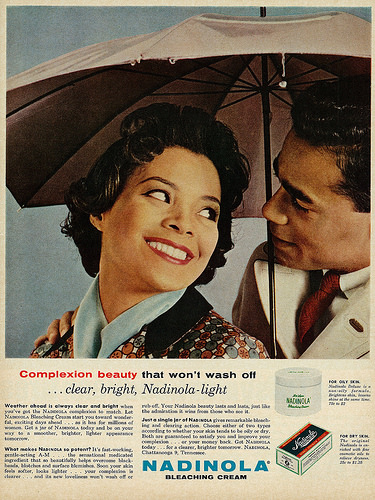
During the ’60s and ’70s, the skin marketing popularity dipped in the 1970’s as the “Black is Beautiful” movement grew. The movement encouraged black people to embrace their natural features, rather than attempt to conform to white beauty norms. Cosmetic companies quickly softened their rhetoric, and the phrase “skin lightening” was changed to the somewhat more innocuous term “skin brightening.” The smiling 1962 ad below promises bright, light skin even on the rainiest day while neglecting to mention the possible side effect of mercury poisoning.  Today, skin lightening continues to be practiced around the world, with particular popularity in Africa, India and Pakistan. The annual global market is expected to reach $10 billion by 2016, though many of the products come with serious health risks.

7 Ways The Beauty Industry Convinced Women That They Weren’t Good Enough

Jotovi Designs Inc

In America, the perennial quest for beauty is an expensive one.

Every year, women spend billions of dollars in exchange for beautiful hair, lovely lashes, and smooth and silky skin. Still, many of our culture’s most common beauty procedures were virtually nonexistent a century ago. The truth is, many of our expectations of feminine beauty were shaped in large part by modern advertisers. We’ve tracked the history behind some of the most common “flaws” that besiege the modern woman and the surprising stories behind their “cures.”

1. “Your natural hair color isn’t pretty enough.”

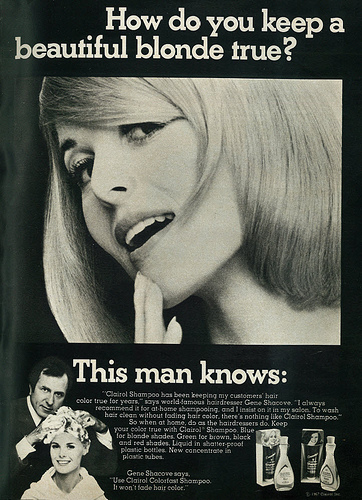
“Does she or doesn’t she?” asked the Clairol’s ad that launched a million home hair dye jobs. Indeed, the aggressive Clairol Marketing would trigger an explosion in sales. In the process, the percentage of women dyeing their hair would skyrocket from 7 percent to more than 40 percent in the ’70s.

The ads showed everyday women reaping the benefits of more lustrous hair, a luxury that had long been exclusive to glamorous supermodels with professional dye jobs. The ads proclaimed, “If I have only one life, let me live it as a blonde.” Indeed, Clairol peddled the perfect yellow shade of the dye as a way to transform your life:

realhairtruth.com

Clairol hair dye offered self reinvention, in 20 minutes flat, particularly for women who didn’t want to reveal their true age or grey roots.

realhairtruth.com

Shirley Polykoff, the advertising writer behind Clairol’s goldmine campaign, described her plan as such: “For big success, we’d have to expand the market to gather in all those ladies who had become stoically resigned to [their gray hair]. This could only be accomplished by reawakening whatever dissatisfaction’s they may have had when they first spotted it.” Clairol did that with ads like, “How long has it been since your husband asked you out to dinner?” Nowadays, about 90 million women in the U.S. color their hair.


Chaz Dean Is In Trouble!

xwvrRwa

A celebrity hairstylist is at the center of a lawsuit involving people from all over the country who have come forward to claim that his hair-care products have caused them scalp irritation, hair loss and more.  Tanya Norman, who also specializes in brand development for a creative agency, is one of these people. Six months after trying the WEN hair product, Norman says she was alarmed at what happened.  “I had started to get a bald spot, and then I found another one in the back, and that’s when I kind of started to get worried,” Norman said. “I started bawling. I couldn’t stop crying.”  Now, attorney Amy Davis is representing nearly 200 plaintiffs from over 40 different states who are part of a mass-action lawsuit against WEN by Chaz Dean Inc.

“Some of the men and women that we represented, looks like they had a weed whacker taken to their head,” Davis described. “Just hair breaking all over.”  Dean, who developed the WEN hair-product line, has a hair-care studio in Hollywood, and celebrities such as Brooke Shields, Angie Harmon.  Davis, however, states that the product traps dirt, oil and debris in the hair follicle and causes scalp irritation.   Davis went on to claim that the celebrity endorsements made women, men and even children believe in the product.  “Their testimonials and Mr. Dean saying that he is the stylist to the who’s-who in Hollywood really made these men and women believe they could trust the product,” Davis said. “Kiddos, kiddos that we represent, have lost nearly all of their hair.”

While  Mr. Dean declined to be interviewed on camera, they released a statement that reads:

“We take great pride in the quality of our products and believe every product meets our high standards. We want all of our customers to have positive experiences with our products. With well over 10 million WEN products shipped since 2008, our customers’ overwhelmingly positive response to WEN is a testament to there benefits it can deliver for its users. These benefits are reflected in consistently high rankings from independent consumer product sites as well. Importantly, there is no scientific evidence to support any claim that our hair care products caused anyone to lose their hair. There are many reasons why individuals may lose their hair, all unrelated to WEN hair products. We intend to vigorously contest the allegations made against our products. And, we encourage any customer with any questions to contact us.”  Norman, meanwhile, now applies a topical medicine and has received 14 cortisone injections in her bald spots. She says that despite her embarrassment, she believes going public with her experience may help others.

wen-by-chaz-dean_featured

“The hair that’s regrowing is very, very fine and brittle. This is something that for me has been very, very embarrassing,” Norman said. “There are a lot of us out there that have been dealing with this issue. You’re not alone.”

The federal judge has issued a stay in the case, and the parties are proceeding to mediation.


Fear The Shear

fear the shear

Started and crafted by Jay Christian Hairdresser in Delaware, and also one of the characters in my next Documentary, The Beautiful Lies”.  This group will collectively serve as a catalyst for change in the beauty industry by restoring the power for the professional, raising awareness of organizations that support this mission, by resisting market penetration of any organization with bipolar marketing strategies; engaging in diversion and unfair pricing practices. We will inspire new talent to expand their way of thinking and to take conscious steps toward restoring power, pride, and prestige to this industry.

Some of the topics of this group come with a wide range of idea’s and personnel philosophy’s. Below are a few of the articles that are debated on this social networking site.

1.  If you can’t measure it, it’s not worth doing. Goals are immensely important to mapping growth. Do you set goals for your staff?  Yourself?  Which ones are most important in our profession?

2.  Just doing what you love won’t make you successful. You’ve got to go after success hard. Never let up. Read everything about the business you love. Learn the BUSINESS of the business you love. Find a mentor. Be a mentor. Get up, dress for it, practice until your icons become your peers. No just loving what you do will not make you successful. Passion, practice, grit, and drive do.

3. That time to is now. We have been holding back because change takes effort. While you’ve been in a state of plausible deniability, they are transferring profits out from under you. Who is willing to seriously make a change? We’ve talked long enough.

4. When someone uses the word “discount” in their marketing idea I cringe. You don’t have to undersell yourself to get clients, you just have to bring value. Do something to show yourself and your salon in a positive light as community contributors, as socially conscientious, you get it. Otherwise, you lower the client’s perception of your value.

Good Luck Jay Christian hope you can change your industry!

Check out the Network My Friends  FEAR THE SHEAR