
On September 14th, California Governor Jerry Brown signed into law the Professional Salon Products Labeling Act (AB 2775). Previously, ingredient labels were not required on professional salon products, leaving workers and consumers in the dark about harmful ingredients. Thanks to AB 2775, companies that sell professional nail, hair, and beauty salon products in California are now required to list ingredients on product labels. As companies move to comply with this new labeling law, the impact will be felt across the country. About time everyone!

At first blush, the beauty industry could be thought to cater only to the glamorous, or perhaps the vain, or maybe just those in the spotlight. And it does – along with everyone else! The industry is built on the product and services that help us look our best – whatever that best may be. It’s more diverse than you think and it’s certainly not just the makeup, hair color and perfume – it’s also the deodorant, toothpaste and even the ear hair clippers. It’s not just the salons – it’s the barber shops, waxing franchises, massage franchises and a whole lot more. It is every product and service dedicated to helping us look – and smell – the way we want, or the way we believe we should for professional reasons. And our definition of beauty is malleable and ever changing – providing never ending opportunities for the industry to innovate.
Historically trends were driven by celebrity taste-makers through their personal choices or professional endorsements. Those days are gone, or nearly so. 82% of women now believe that social media drives these trends. It’s a constant flow of information and opinion from not just trendsetters or celebrities, but from friends and friends of friends and an entire universe of strangers. But however they are set, there is a large industry ready, willing and able to cater to them. It is resistant to economic downturns and poised for even more growth. For the entrepreneur there are plentiful representative sales opportunities within companies like Avon or Arbonne and many more traditional franchising opportunities providing a slew of services.
As it turns out, it takes a lot of effort to keep us looking and smelling our best – an absolute army of products and services, in fact. Cosmetics, skin care, hair styling, hair coloring, hair removal, nail salons, tanning salons, massage parlors and luxury spas, shower and shaving product, perfumes, colognes…and a whole lot more. And that’s where it starts to get interesting – within each of these segments are products for every different skin tone or texture, allergy, age, hair type or color, sex – even the time of day! It is a level of diversity and nuance that may go unnoticed to the casual observer. Some of us, in fact, are overwhelmed by all those rows of shaving cream. But increasingly we are the minority – most consumers care, are discerning, and will try a number of different products before finding something that works. Once they find it, however, brand loyalty – whether for a shampoo or a particular salon – is extremely strong.
Producers differentiate themselves through their target demographic markets, price point and with different manufacturing processes. Products that promise no animal testing or that are all natural, for example, have loyal, niche markets and can often charge a premium.
Service providers compete primarily through price, location as well as their target demographic markets. Types of service and the related products that are offered are vital to profitability. Hair salons and barber shops, for example, rely on 5-15% of their revenue from hair care product sales. The beauty industry is known to be resistant to economic downturns – even faring well during the Great Recession of 2008. Though consumers tend to be more price conscious during those times, they do not stop spending. So in today’s environment of rising per capita incomes the beauty business is booming. In 2015 the industry generated $56.2 billion in the United States. Hair care is the largest segment with 86,000 locations. Skin care is a close second and growing fast, expected to have revenue of almost $11 billion by 2018. This growth is being driven in part by a generally increasing awareness of the importance of skin care, but also specifically due to an increase in the market for men.
According to the Bureau of Labor Statistics, there are nearly one million people employed in the primary service segments of the market, and there are strong growth expectations. Clearly this is an industry on the rise:
As mentioned above, it’s important to remember that many beauty franchises derive up to 15% of their revenue from product sales; putting the right product on the shelves can make or break a business. Some manufacturers have a franchising distribution system of their own and even offer training programs, or partner with a particular service provider. With strong and growing demand, employment estimates through the roof to meet that demand and a strong history of being a steady business even in turbulent times, the beauty industry continues to provide fantastic opportunities.
About frigging time, say goodbye bye to free labor. People deserve to be paid. Especially for sitting there waiting for a customer. Time is money. The ol trick of hiring a professional and giving them a chair and telling them they have to build up there clientele when they answer a advertisement for employment will be gone. That old trick is history, and should teach salon owners labor is not free. Good for the industry this should keep the owners honest. The industry was built on free labor. Pay back time. How can a professional come to work worrying about rent, food, electric, transportation etc if they work on commission. Salon owners will say I can’t do that, then you shouldn’t have opened a salon. Now I will wait for all the know it all’s to reply. Please do I love debate. I have watch professionals I have worked with in my 33 years of this industry, ripped offed, taken advantaged of, and done so much wrong to they have gotten out of the profession. Its interesting how salon owners can come up and blame the professionals. And assume that with your words that all are alike. “Have to pay people to sit in the break room, on their cellphones, bitching about how they are not busy.” Well not everyone in this industry does what you say. I’m glad to see this, it should have happened along time ago. I love it! Boo Hoo for the salon owners, good for the employees. The employees are what make you. About time this happened, I love all the new ways and new roads the industry is changing. Be your own Boss everyone Don’t live other peoples dreams. You will have nothing in the end. Especially in the Beauty Industry!, Hah!
Note: Although CA employment attorneys were consulted when researching this article, we highly recommend that you contact a legal representative to discuss your rights and responsibilities on this topic. Strategies is not a legal counsel and the contents of this article should not be considered as such. We will be updating this post as more information is presented to us.
Commission salons and spas in California were just given the ultimate “Bad Hair Day”.
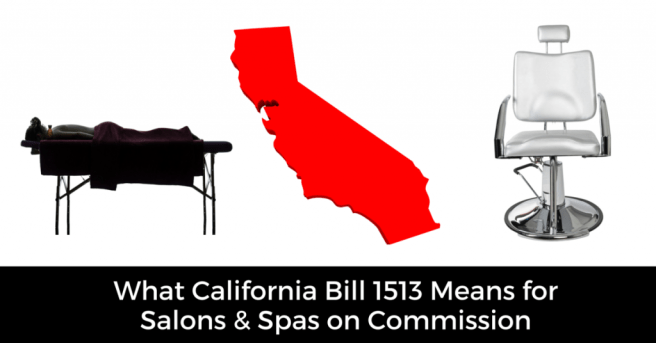
With the passage of California Bill 1513 “piece-rate legislation”, the rules have completely changed on how salon and spa owners can compensate their stylists and massage therapists.
For all intents and purposes, the traditional commission model is no longer compliant in California. Strict new laws now require salons and spas to drastically alter they way they compensate their commissioned employees.
And unfortunately, the potential financial impact of Bill 1513 on many salons and spas could be catastrophic. See the full bill here.
Piece-rate vs. commission compensation:
As per the Labor Code, compensation for salon/spa services is technically labeled as “piece-rate” work, and not commission. Confused? Let’s look at the Labor Code’s definition of each classification:
Because stylists and massage therapist are rendering services and not just selling them, their work is considered “piece-rate.” Why does this labeling matter? Because Bill 1513 only applies to piece-rate work and not commission work. But again, the Labor Code’s definition of commission is not the same as the salon/spa industry’s.
Big game changer #1…
Effective January 2016, all “piece-rate” California salons and spas must track, report and pay their stylists or massage therapists for “non-productive” and “rest/recovery” time.
“Non-productive time” is defined as the time employees are required to be at work, but are not actively servicing clients. This includes time…
“Rest/recovery times” is defined as time…
In other words, every minute that services providers are in the salon/spa and are not either servicing a client or on break, needs to be tracked, reported and compensated for.
The “non-productive” and “rest/recovery” pay rates must be at least the California minimum wage.
Big game changer #2…
And it’s a biggie…
The law states compensation for “non-productive” and “rest/recovery” time must be a separate pay rate from the rate paid for when services are being produced.
This means you are no longer allowed to average the total dollars paid by the total hours worked and let that cover both “productive” and “non-productive/rest” hours.
Previously, as long as the averaged hourly rate equaled or surpassed minimum wage, all was good.
This is no longer the case.
Big game changer #3…
In addition to aforementioned restrictions, Bill 1513 also contains one final crippling blow for California-based commission salons and spas:
Now let’s do some math…
How this scenario would look under Bill 1513…
Salon Sacramento’s back wages due on all “non-productive” hours since July 1, 2012
So where do commission-based California salons and spas go from here? One thing is clear, the days of easily calculating 50% for them and 50% for the house are gone.
Here are four employee-based compensation structures for California salons and spas moving forward:
As counter-intuitive and debilitating Bill 1513 is to the California salon/spa landscape, it is not something not to be taken lightly. If you are not pro-active in making the necessary changes now, you could be facing state fines, employee lawsuits for back wages or both.
Your first step should be to talk to a legal representative to learn what your legal rights and responsibilities are with Bill 1513. They will also have a very firm understanding of the bill as more details and cases are presented.
Your next step should be to restructure your pay structure to meet all compliance standards. If you would like one-on-one help from our team of Certified Strategies Coaches to quickly execute the restructuring of your compensation system to Team-Based Pay, click the link below. Not only will we ensure you meet all Bill 1513 guidelines, we will help you implement a pay program that can increases sales and profits, motivate your staff to grow the business, and provide world-class customer service.
Click here for hands-on help from a Strategies compensation expert.
Note: We highly recommend that you contact a legal representative to discuss your rights and responsibilities on this topic. Strategies is not a legal counsel and the contents of this article should not be considered as such. We will be updating this post as more information is presented to us.

 The Real Hair Truth
You must be logged in to post a comment.