Think Real Good Before Using These Cosmetic Products

Keratin Hair Products

What are they? Keratin is the protein from which hair is made. Many shampoos and conditioners claim to include keratin and promote the protein’s restorative qualities. The products’ labels say they can repair damage caused by over-processing.  Why should you think twice? Most hair products that advertise the benefits of keratin don’t actually contain it or even specifically target the protein. To make matters worse, there is no evidence that keratin additives benefit hair health or growth.  As a result, ClassAction.com has filed a false advertising lawsuit against Matrix and L’Oreal, claiming their products do not contain keratin and therefore are unable to provide the benefits they advertise. If you have purchased keratin hair products made by these companies, contact us today to find out if you are owed money.

Hair-Smoothing Products with Formaldehyde

What are they? Hair-smoothing products are meant to control frizz and curls for an extended period of time; they often contain formaldehyde. The application process is usually done in a professional salon and requires heat from a flat-iron or blow dryer.  Why should you think twice?  When formaldehyde and related ingredients such as methylene glycol are heated, formaldehyde gas is released into the air, which can be hazardous to your health. The FDA and The Occupational Safety and Health Administration (OSHA) have issued warnings about Brazilian Blowout Acai Professional Smoothing Solution and Brasil Cacau Cadiveu, citing safety and labeling violations.  Exposure to formaldehyde can cause health problems such as headaches, dizziness, nausea, chest pain, respiratory-tract problems, eye irritation, rash, and more. The labeling violation letters allege that the product labels do not warn people of these potential harmful effects.  The FDA recommends avoiding products that contain formaldehyde, formalin, or methylene glycol, and to report any adverse reactions.


“Natural” Products that Contain Synthetic Ingredients

What are they? Due to increasing consumer demand, many brands are starting to create more “natural” products and trying to stay away from using synthetic and artificial ingredients.  Why should you think twice?  In recent years, certain brands have come under fire for labeling products as “natural” when in fact they contain synthetic and chemical ingredients. In 2016, Unilever settled a class action suit levied against its TRESemmé Naturals product line for $3.25 million and discontinued the line.  Another class action suit was filed in February 2017 against Procter & Gamble’s Herbal Essences Wild Naturals line for misleading labels and false advertising.  If you purchased a Babyganics, keratin, or other hair product and think you fell victim to false advertising, contact us for a free legal consultation. You could be eligible for a class action lawsuit.


WEN® by Chaz Dean

What is it? Founded by celebrity hair stylist Chaz Dean, WEN® is a line of sulfate-free hair care products. The WEN Cleansing Conditioner promises to clean, nourish, moisturize, detangle, and strengthen hair, all in one product and without the use of harsh sulfates. WEN’s website says it has sold over 40 million products since 2008.  Why should you think twice? In 2015, more than 200 women joined a class action lawsuit claiming that use of the WEN Cleansing Conditioner led to extreme hair loss, hair breakage, scalp irritation, and rash.  The lawsuit also alleged that WEN misled customers with deceptive marketing, and that the company blocked or removed negative comments and reviews from its website and social media pages.  WEN settled that lawsuit for more than $26 million. The FDA is currently investigating the cleansing conditioner and warns consumers to stop using the product if they experience any adverse reactions.


Babyganics

What is it? Babyganics is a Westbury, New York-based company that claims to sell baby-safe, organic household and childcare products (shampoos, lotions, wipes, detergents, etc.). It has grown rapidly over the past 15 years, generating $30 million in revenue in 2013 and securing a sale by SC Johnson in 2016.  Why should you think twice? Many parents allege that Babyganics products are not as organic or kid-friendly as they appear.  As a result, multiples lawsuits have been filed against Babyganics in recent years.  A class action suit filed by ClassAction.com alleges that Babyganics misled consumers through labeling that claimed certain bath products were “tear-free,” gentle, non-allergenic, and safe for infants—when in fact they contain substances that are eye irritants. Another class action lawsuit filed in September 2016 alleges that products labeled as “organic” or “mineral-free” actually contain ingredients that are neither.  One mother also claimed that Babyganics baby wipes caused her five-week-old baby to break out with a bumpy rash on his face.  PrMost serious of all, Theresa Jones alleges that Babyganics’ tear-free shampoo burned her son Hunter’s eyes, potentially causing serious and permanent damage.
Terms You Should Know In The Beauty Industry.


  • Free From~ This statement has become the mantra for large commercial brands, with the smaller brands following suit as a way to convey that their product is somehow safer than their competitors.
    • Danger of Claim: It can reinforce the idea that if something is “free from” a certain ingredient, that the missing ingredient is somehow “dangerous.”  And what was once part of the formula has since been removed, when it may have never been in the product in the first place.  This is marketing to the consumer that has been led to believe natural is better and everything else will kill them. Example: Parabens, sulfates, etc. get a bad rap, when there is actually scientific data that shows these are perfectly safe for personal care use in the recommended dosages within the cosmetic formula.  Or if it is a leave on or rinse off product will also determine ratios.  Any chemical in its full strength has the potential for causing harm, yet these are not offered to the end user, ever.
  • Chemical Free~ Another claim that bears no reality in truth or common sense.  Nothing formulated can be without chemicals as all things are chemical…natural or synthetic, makes no difference, it is just the manner in which they are derived or created.  Again, shamelessly used for SCARE tactic marketing.
    • Danger of Claim: This connotes the idea, all things chemical are hazardous to our health…..think of water, essential oils, olive oil, etc…..these appear to be benign now don’t they? However, from the point of view of the overstated 60% absorption claim, these are all potential penetration enhancers.  This claim also overlooks the fact of what the product is packaged in.  There is no getting around the chemical processes that goes into creating the packaging, such as a jar or tube, technically.
  • Hypoallergenic or Noncomedogenic~ These terms are not even recognized by the FDA and there actually isn’t any proven data in clinical trials, and has yet to be tested by the US Food and Drug Administration as to the validity of such terms.
    • Danger of Claim: Any ingredient could cause a problem for any individual and this connotes that it won’t cause a problem….sorry, but trial and error only, unfortunately.  Up to 10% of the population can and will have a reaction to something the majority of the population won’t have.  This includes a developed allergy after using an ingredient for years.  Our bodies are ever changing.  Those with acne may have a similar reaction. What won’t cause acne on one individual may be horribly occlusive to another.
  • Dermatologist / Clinically Tested~ This is a claim that can be made based on a single doctor trying it out on themselves or a patient.  Based on this perception it is theorized by the end user, it must be a proven product. A clinical study performed by the manufacturer on a small number of people will not constitute nationally, what can occur if millions use the product.
    • Danger of Claim: Gives the perception that it must be safe and work because a doctor or a clinical study said so, but is not necessarily the reality. Safety and efficacy data will change as high volume of users join the pool, and this is PURE marketing! 
  • Anti-aging Formula~ This ties into penetration enhancers being utilized within a skin cream and are designed to assist beneficial ingredients in penetrating into the otherwise impermeable surface layers of the skin to restore soft, supple skin with more elasticity.
    • Danger of Claim: EWG and Campaign for Safe Cosmetics have underscored this message as a penetration enhancer being the carrier of chemicals to the blood stream.  When in reality, penetration enhancers for the purpose of cosmetics are only skin deep and are not geared toward penetration through the dermis layer into the blood brain barrier as would be the desired effect with a topical drug.  Permanent change does not occur with any cosmetic, and only maintains the skin as long as the product is being used.
  • Non Toxic / Harmful Chemicals~ What does this even mean?  Who and what entity is deciding what is toxic or not?  This is yet to be determined and will continue to be debatable since EWG and CFSC think anything, other than naturally derived, is toxic to our bodies.  The majority of scientific research does not support the validity of this marketing claim.  Plus, too much of anything natural or synthetic can cause issues for some.
    • Danger of Claim: This statement plays into the fears of the consumer and reinforces the CFSC’s campaign rhetoric against beauty industry leaders and their products.  Such as lead being added to lipstick which is categorically FALSE and is considered a contaminant, which is found also in drinking water and the foods we eat that are grown in the ground.
  • 100% Pure / Natural / Organic~ This connotes that only natural chemicals are safe for the body and that synthetic chemicals are the bane of our existence and will give us cancer or worse. There is no human scientific data to support this claim.  And animal studies do not extrapolate to humans despite how hard watchdog groups try to convince us.
    • Danger of Claim: Beauty products labeled as natural are less tested and scrutinized than are synthetic products and pharmaceuticals. In fact, most compounds as they exist in their natural state cannot be formulated into skin care products. They first must be chemically altered before they can be incorporated into cosmetics, thereby negating the claim of being pure and natural.
  • FDA Approved ~ This marketing claim gives the unwitting consumer the idea the product is endorsed by the FDA, and the product must have been tested by the FDA to show proof of the companies claim of safety and / or efficacy.
    • Danger of Claim: This is outright FALSE and is actually in violation of FDA regulation.  FDA does not approve any finished product for the end user in the cosmetic and beauty industry.  Only prescription and OTC drugs and medical devices are FDA approved for their intended purpose.
  • Does Not Contain Fillers~ This marketing claim is designed to intimate that their product is formulated with nothing but pure and essential ingredients only, and that no fillers are used to create a less than desirable product, supposedly.
    • Danger of Claim: This insinuates that somehow a filler ingredient is cheap and makes another product substandard.  Unfortunately, this bears no weight in actual truth.  Those that claim their ingredients are the ultimate and then claim fillers as bad, are also ingredients that are used as filler.  Mica for instance is not only an essential ingredient to the formulation of the majority of mineral makeup, but it is also a FILLER ingredient.  By definition a filler ingredient is used for finish of product, bulking agent, or any ingredient utilized for the desired effect for smooth application.  There is no actual separation of the two.  Water can be considered a filler ingredient, since it is not typically essential but makes up the bulk of many skin care products.
  • Non Irritating~ This gives the end user of a product the assurance that their otherwise sensitive skin, will not have any problem with the product.  This expands on item 3.
    • Danger of Claim: The problem with this claim is everyone’s skin is different.  There are ingredients that have a long standing history of safety and efficacy, yet there will be the small percentile that will have irritation when using it.  Mineral makeup for instance works well for the majority of women, Bismuth Oxychloride excluded, but for a small number, no matter how much they hope, they will always have an irritant reaction and can never wear minerals, no matter its’ popularity.  We disclose this fact, by using only ingredients with known lower irritant risk factors, but still, only the end user will determine what is right for their skin or how they’ll react through testing it on themselves. It may not be a single ingredient, but when used in combination with another or its presumed ratio, is where the problem lies.  So by not purchasing something because one may see a certain ingredient of concern, they may be missing out on what otherwise could be fantastic for their skin.   Always TEST…TEST…TEST the product for absolute certainty.


7 Ways The Beauty Industry Convinced Women That They Weren’t Good Enough

Jotovi Designs Inc

In America, the perennial quest for beauty is an expensive one.

Every year, women spend billions of dollars in exchange for beautiful hair, lovely lashes, and smooth and silky skin. Still, many of our culture’s most common beauty procedures were virtually nonexistent a century ago. The truth is, many of our expectations of feminine beauty were shaped in large part by modern advertisers. We’ve tracked the history behind some of the most common “flaws” that besiege the modern woman and the surprising stories behind their “cures.”

1. “Your natural hair color isn’t pretty enough.”

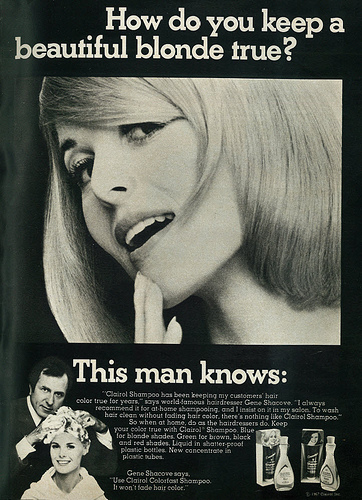
“Does she or doesn’t she?” asked the Clairol’s ad that launched a million home hair dye jobs. Indeed, the aggressive Clairol Marketing would trigger an explosion in sales. In the process, the percentage of women dyeing their hair would skyrocket from 7 percent to more than 40 percent in the ’70s.

The ads showed everyday women reaping the benefits of more lustrous hair, a luxury that had long been exclusive to glamorous supermodels with professional dye jobs. The ads proclaimed, “If I have only one life, let me live it as a blonde.” Indeed, Clairol peddled the perfect yellow shade of the dye as a way to transform your life:

realhairtruth.com

Clairol hair dye offered self reinvention, in 20 minutes flat, particularly for women who didn’t want to reveal their true age or grey roots.

realhairtruth.com

Shirley Polykoff, the advertising writer behind Clairol’s goldmine campaign, described her plan as such: “For big success, we’d have to expand the market to gather in all those ladies who had become stoically resigned to [their gray hair]. This could only be accomplished by reawakening whatever dissatisfaction’s they may have had when they first spotted it.” Clairol did that with ads like, “How long has it been since your husband asked you out to dinner?” Nowadays, about 90 million women in the U.S. color their hair.


Chaz Dean Is In Trouble!

xwvrRwa

A celebrity hairstylist is at the center of a lawsuit involving people from all over the country who have come forward to claim that his hair-care products have caused them scalp irritation, hair loss and more.  Tanya Norman, who also specializes in brand development for a creative agency, is one of these people. Six months after trying the WEN hair product, Norman says she was alarmed at what happened.  “I had started to get a bald spot, and then I found another one in the back, and that’s when I kind of started to get worried,” Norman said. “I started bawling. I couldn’t stop crying.”  Now, attorney Amy Davis is representing nearly 200 plaintiffs from over 40 different states who are part of a mass-action lawsuit against WEN by Chaz Dean Inc.

“Some of the men and women that we represented, looks like they had a weed whacker taken to their head,” Davis described. “Just hair breaking all over.”  Dean, who developed the WEN hair-product line, has a hair-care studio in Hollywood, and celebrities such as Brooke Shields, Angie Harmon.  Davis, however, states that the product traps dirt, oil and debris in the hair follicle and causes scalp irritation.   Davis went on to claim that the celebrity endorsements made women, men and even children believe in the product.  “Their testimonials and Mr. Dean saying that he is the stylist to the who’s-who in Hollywood really made these men and women believe they could trust the product,” Davis said. “Kiddos, kiddos that we represent, have lost nearly all of their hair.”

While  Mr. Dean declined to be interviewed on camera, they released a statement that reads:

“We take great pride in the quality of our products and believe every product meets our high standards. We want all of our customers to have positive experiences with our products. With well over 10 million WEN products shipped since 2008, our customers’ overwhelmingly positive response to WEN is a testament to there benefits it can deliver for its users. These benefits are reflected in consistently high rankings from independent consumer product sites as well. Importantly, there is no scientific evidence to support any claim that our hair care products caused anyone to lose their hair. There are many reasons why individuals may lose their hair, all unrelated to WEN hair products. We intend to vigorously contest the allegations made against our products. And, we encourage any customer with any questions to contact us.”  Norman, meanwhile, now applies a topical medicine and has received 14 cortisone injections in her bald spots. She says that despite her embarrassment, she believes going public with her experience may help others.

wen-by-chaz-dean_featured

“The hair that’s regrowing is very, very fine and brittle. This is something that for me has been very, very embarrassing,” Norman said. “There are a lot of us out there that have been dealing with this issue. You’re not alone.”

The federal judge has issued a stay in the case, and the parties are proceeding to mediation.


So Far The Beauty Industry in 2015 at a Glance

real hair truth

Comprised of a diverse yet interrelated set of business lines, the beauty industry helps us look and smell our best. Before we leave the house each day, we have likely undergone our personalized beautification ritual. Included in this ritual is the daily shower and shave, the weekly nail trim, and the monthly haircut. And increasingly we are taking a more holistic view of our health, and our beautification ritual may now include a periodic massage and trip to the spa. But our concern with our appearance is hardly anything new; indeed the beauty industry has been expanding and growing for all of recorded history. For the interested entrepreneur this continuing growth and evolution offers a diverse menu of opportunity.

The beauty industry today encompasses far more than cosmetics and skin care products, though they are still a significant portion of the sector. A wide range of services and products are available to help us put our best face forward, and the beauty industry now also encompasses hair styling and hair removal, nail and tanning salons,massage parlors, shower and shaving products, perfumes, colognes and more. Many people now treat their beauty ritual as an escape from the hustle of the information age, whether its a few minutes spoiling oneself with a high-end product or a full day at a luxury spa.

Lotions, Treatments and Baths. Oh my!

Beauty industry opportunities can be broadly separated between products and services, though many providers offer both. Within both products and services, however, exist a wide range of business models based on target market, production processes and location.

From exfoliating soaps and volumizing shampoos to anti-wrinkle creams, the beauty industry provides us with choices galore to keep us looking younger and healthier. Cosmetics exist for every style and taste, as well as every skin tone, texture and even allergy. Rows of toothpaste stretch off into the distance at the local retail outlet, and it is no longer a choice only of brand, but between whitening, tartar protection, flavor, packaging styles and more! And a similar story is told in the aisles for perfume, deodorant and hair coloring. Certain businesses also distinguish themselves through manufacturing processes such as using all natural ingredients or a refusal to use animal testing on products.

While the diversity among service providers is not quite as extensive, there is considerable differentiation between offerings based on price, location and target markets. Some businesses target the inexpensive, fast hair cut market while others focus on providing a luxury spa experience. Franchise opportunities exist for hair salons, skin treatments, nail care, and tanning. Niche providers offer products and services focused on children, weddings,  and fashion, among others.

Different Beauty Franchise Opportunities

  • Hair Care
    • Stylists
    • Salons
    • Shampoos/Conditioners
    • Coloring Product
    • Styling Product (Gels, Sprays, etc.)
  • Cosmetics & Skin Care
    • Make-Up
    • Moisturizing Lotions
    • Tanning Salons
    • Sun Care Products
  • Fragrance

    • Perfumes
    • Body Sprays
    • Cologne
    • Deodorants
  •  Miscellaneous
    • Nail Polish
    • Shaving Products
    • Massage Parlors
    • Hair Removal Service

Beauty Industry Trends

Such diversity and innovation exists because we demand it. The beauty industry continues to expand globally, with some projections claiming 8.5% growth by 2014; revenue growth in 2010 is estimated at 3.3%. Several trends support this expansion and promise continued profitability into the future.Globally, rising per capita incomes and greater access to international markets are increasing spending on discretionary items such as perfumes and cosmetics. Though the recent economic turmoil had decreased spending on some discretionary products in the United States, purchasing of beauty products has remained strong. Consumers did tend to be more price-conscious however, with over 70% of survey respondents claiming to give mass market products more consideration over high-end products during the downturn.

Perhaps not as surprising as it once was, one of the fastest growing segments of the beauty industry is products and services aimed at men. Traditionally focused on female consumers, men today are gaining increasing attention from the beauty industry. Of course most of us have been using deodorant and toothpaste for several months already, but increasingly men are being targeted for body sprays, specialty hair products, lotions and even nail care. Salons offer a menu of pampering services for men, including cuts and shaves, facials, massages and manicures.

Consumers of beauty industry products tend to be brand loyal, and share what works for them with their friends. 58% of those surveyed claimed that personal recommendations weigh more heavily than celebrity marketing, and only 44% bought a particular product for its claim of specific product attributes. Like many things, beauty products gain a level of familiarity and comfort for the consumer, and switching to a new product often takes some extra incentive. Popular and successful marketing campaigns in the beauty industry often include a free sample and discounts for referrals to lure new customers in, and loyalty programs to keep them.

Beauty Industry Franchise Opportunities

From product innovation, organic industry growth and continued growth into the male half of the population, the beauty industry continues to offer a diverse set of profitable franchising opportunities. Beauty franchises exist across the space with dozens of strategies reaching all types of consumer.

Retail opportunities include brick-and-mortar store locations as well as home-based businesses, and span across cosmetics, skin care, hair care, tanning and more. Frequently producers of beauty industry products will have a franchising distribution system, or even have training locations for service providers. Cosmetic and skin care entrepreneurs offer specialized services such as nail care and tanning, a complete menu designed for the full day experience and everything in between. Some salons offer an exclusive membership experience and others specialize on walk-in business.

Hair care opportunities exist for barbers and stylists alike, with a range of different franchises available based on cost, location, and gender. Many male-focused franchises offering everything from the basic barbershop to “the ultimate relaxed grooming experience” have been springing up to complement the traditionally female-focused salon offerings. Franchise chains devoted to children offer a more entertaining environment for kids. There are also businesses focused on hair removal and coloring. Eco-friendly salons such as the Splish franchise offer hair care in an environmentally conscious environment.

As we can see, the beauty industry encompasses a wide range of products and services, and franchising plays a major part in bringing them to the consumer. As the industry continues to grow and evolve, profitable opportunities will abound…the hard part is choosing which one!