Frédéric Fekkai Buys Back His Brand

Frédéric Fekkai, in partnership with Cornell Capital LLC, has taken back the brand he started by acquiring Frédéric Fekkai Brands.

Fekkai Brands creates hair and body care products, including shampoos, conditioners, treatments, hair fragrances and styling products. Additionally, the company owns and operates a number of salons across the US.

Fekkai, who founded his namesake brand in 1996, sold it in 2008 to Procter & Gamble. P&G then sold the brand in 2015 to a joint venture formed between the CEOs of Designer Parfums and Luxe Brands.  The ownership group selling off the company includes Dilesh Mehta, Tony Bajaj, Joel Ronkin and Amy Sachs

Blue Mistral LLC, a holding company founded by Fekkai and Cornell Capital, will own and operate Fekkai Brands together with Bastide, a fast-growing Provence-based provider of luxury fragrances and hand and body care products that Fekkai has led since 2017. As CEO of Blue Mistral, Fekkai will further accelerate the growth of the Fekkai Brands and salons by placing a heightened emphasis on education, innovation and the customer’s overall experience while leveraging opportunities for collaboration with Bastide.

“I am thrilled to rejoin Fekkai Brands and eager to reconnect with the salons, teams and consumers,” said Fekkai. “This acquisition will provide me the opportunity to reinfuse my passion for innovation into the brand, while reigniting its growth and guiding Fekkai Brands through its next chapter in a modern and exciting way.”

“The opportunity to partner with Frédéric, a proven entrepreneur in the beauty sector, as he returns to the helm of his iconic brand is truly compelling,” said Henry Cornell, senior partner of Cornell Capital. “Leveraging Cornell Capital’s cross-border network and operational expertise, and Frédéric’s deep relationships and reputation within the industry, Fekkai Brands is well-positioned to succeed in the growing global cosmetics and personal care industry.”

Ronkin, exiting CEO of Fekkai Brands added, “Frédéric is an accomplished entrepreneur with a proven track record of building highly desirable brands. We are confident that his return to the Company will be instrumental in fueling its growth and driving innovation.”

The Value of Cosmetology Licensing

 All cosmetologists, barbers, manicurists, skin care specialists and makeup artists in America are trained and licensed beauty professionals from accredited cosmetology schools. Professional beauty programs offer courses to teach individuals skill sets to enhance clients’ appearances hair, nails, skin, and makeup and maintain a safe salon environment.
One of the most valuable features of all professional beauty programs ,from a comprehensive cosmetology program to a shorter nail technology program, is safety and sanitation training to minimize the transfer of infectious diseases and risk of accidents for clients. Upon completing their training, students who pass their exams are awarded certificates and licenses to work in hair salons, barber shops, nail salons, spas and other personal care service facilities. Currently, professional beauty licenses are set and administered by state offices and the requirements vary from state to state and specialty to specialty.
Among the various disciplines with in the beauty industry, cosmetologists and barbers usually undertake the most comprehensive programs that cover multiple teachings and skills from safety, sanitation and technical skills to customer and business management skills.  Full time programs in cosmetology and barbering range from 9 to 24 months and can lead to associate’s degrees in cosmetology. Professional cosmetology schools also offer shorter, more affordable programs such as nail treatment, skin care and hair styling designed to teach specific skills to work in the beauty industry. Upon completion of study, beauty professionals take exams to demonstrate their knowledge, skills, and capabilities required to perform their jobs. After passing required exams they are awarded with certificates and licenses to work at hair salons, barber shops, nail salons, spas, nursing facilities and performance art centers.
Registered professionals are proven to be accountable for the benefit of the consumer. Professional beauty licensing is an essential component to the health of America’s economy and to the health of its citizens. Beauty professionals touch nearly all Americans across every demographic in large and small communities. These professionals acquire their special skills to provide safe, high quality services to their clients through extensive training, certification and licensing. The professional beauty industry is a critical element in America’s economic landscape and professional beauty licensing is an essential component to the overall health of American consumers and beauty professionals.
Ultimately, licensing of beauty professionals supports an industry of over 2.2 million workers who earn $31.6 billion in wages and contribute $85.8 billion in goods and services to the U.S. economy. The beauty industry is dominated by small businesses, self-employed individuals and exemplifies gender and ethnic diversity. The beauty industry touches almost every American in large and small communities. These trained professionals attend accredited institutions to acquire special skill sets, including hair, nail, skin treatments, business management, sanitation, hygiene, human anatomy, and infection control to provide safe and high quality services for their clients. As with other professional education programs, participants have to pass standardized course exams to demonstrate their knowledge and ability to perform their skills in the marketplace.
With a higher level of training, beauty professionals are able to earn higher wages. Licensing safe and well-trained beauty service providers protect customers from unqualified beauty workers. To ensure consistency from state to state, industry professionals are pushing to harmonize the requirements and  processes to obtain professional beauty licensees to strengthen safety, remove barriers and ensure economic performance of the industry.

Cosmetology Schools, Salons Square Off Over Battle To Change Licenses

A bill to overhaul training standards for cosmetologists was lying dormant until it suddenly gained momentum this month, passing out of a House committee. Now opponents are scrambling to rally against the bill, saying it waters down the license. But supporters argue that this bill is needed to help the state’s salon industry thrive. “So if I don’t want the bleach to touch this part of the hair I’m gonna use the foil to block it.” Katie Groezinger is meticulous, as she lays one narrow strip of foil after another onto her client’s hair. She’s standing next to her salon chair at The Spa School in Worthington. Groezinger, a cosmetology student, then grabs a small brush and begins to add another layer of color to a different strip of hair.  “We’re making her regrowth a little darker,” said Groezinger. She’s doing what’s known as a balayage. It’s a new, trendy technique that darkens a person’s hair starting at the roots and gradually works its way down, transitioning to a different color, in this case a lighter blonde. “Brightening it back up for spring.”

Groezinger is 300 hours away from earning an advanced cosmetology license, a license that would be eliminated if a bill that’s sitting in the Ohio House were to pass. “I will put our 1,500 and 1,800 hour education up against anybody in the United States, we teach complete cosmetology,” said Sue Carter Moore, president emeritus of the Salon Schools Group, which provides training for cosmetologists.  “And to reduce that for self-serving salon owners and national chains who wish to have fast graduates is absolutely wrong,” she said.  The proposed change to cosmetology standards in Ohio is comprehensive. Along with reducing instruction hours and getting rid of the advanced cosmetology license, it eliminates the natural hairstyling license and other advanced licenses dealing with nail and skin care.  Because the bill deals with so much, there are several voices sounding off for and against the measure. But perhaps the most heated debate is between two groups; Carter Moore and her association of private cosmetology schools versus salons.  Elizabeth Murch represents the Ohio Salon Association, which firmly supports the bill. She says these changes are crucial to keep up with a growing need for cosmetologists.  “The main crisis isn’t moving to 1,000 hours the main crisis is that schools are closing; the Dayton area has been hit significantly with school closures which then provides difficulty for any salon to find qualified individuals to work,” Murch said.

She says this is the standard that’s already in place for anyone getting a cosmetology license from a public vocational and career tech schools. Murch argues that 1,000 hours is an adequate amount of time to teach students about safety and sanitation measures, which she says are the only thing the state should be regulating. “The standard cannot be unfair and we should be legislating safety and sanitary practices entering this profession. We cannot legislate a good haircut,” said Murch. “I’m personally offended,” Carter Moore replied. Carter Moore with the Salon Schools Group says that’s dramatically underselling the value of cosmetology education. “This business is constantly evolving with different products new techniques and new chemicals that we’re working with,” Carter Moore added. As Murch points out, EMTs, police officers, nurses, and tattoo artists are all required to participate in significantly less instruction.

She adds that people can get extra education on the salon floor as employees rather than students at expensive private school that can take a long time to pay off. “Most of that 500 hours is made up on the clinic floor where the students are providing services not being paid but they are providing services and the school is making money,” said Murch.  Carter Moore says students get real first-hand experience at a school rather than being relegated to assistants in salons. She adds that the advanced licenses give students the confidence to go straight to starting their own business without signing contracts with salons. So, as Carter Moore puts it, this bill can help salons reduce competition.  “When you have people go into a salon loft as an independent contractor it certainly does dry up the pool of available employees for the chain salons and I’m going ‘gee’ maybe that’s what’s behind this legislation,” Carter Moore said.

Murch says there’s nothing stopping the cosmetology schools from still teaching a 1,500-hour course. Carter Moore says they can do that but students will still only walk away with a state license that says they completed 1,000 hours of instruction.  Back at The Spa School, Groezinger doesn’t regret the 1500 hours of instruction she’s received, saying it’s a craft that needs to be honed.  “I don’t think 1,000 hours is enough for anyone to be professional at what they’re doing I don’t think a doctor would be like ‘hey you got 1,000 hours of anatomy you can go cut someone open.”

The bill also allows the state to recognize a cosmetology license from any state that requires 1,000 instruction hours or more. But, as Carter Moore points out, if lawmakers approve the changes then an Ohio license won’t qualify in other states with higher standards, including every state that borders Ohio. The bill has passed a House committee and now awaits a vote in the full House chamber before moving to the Senate.
Monat Class Action Lawsuit Already


A new class action lawsuit alleges that Monat Global Corp. promotes its hair-care products as being able to help growth, but consumers say they actually lost hair and experienced irritation after using the products.

Lead plaintiffs, Trisha Whitmire and Emily Yanes de Flores, allege in their class action lawsuit that they and others purchased Monat hair care products because they were promised aid in hair growth and health; however, say the plaintiffs, the chemicals in the products actually lead to increased hair loss. They say the misrepresentations are part of a scam by Monat to get consumers to purchase even more expensive products from them. Both plaintiffs allege that they experienced significant hair loss after investing substantial sums in Monat products. They say they brought their concerns to the company, but were told they were going through a “detox” process and would see healthier hair if they continued to use the Monat products. They say the company also pointed the finger at suppliers when they continued to complain.

“Shamefully, hair loss claims are met with unsubstantiated claims of a ‘detox’ period that will cause increased hair loss before the purported benefits of Monat hair care products accrue or worse yet, suggestions to spend more money on still more expensive Monat haircare products,” the Monat class action lawsuit states. Frustratingly, allege the plaintiffs, the hair loss does not stop, even after consumers stop using the Monat products. According to the Monat class action lawsuit, Monat advertises its products as “naturally-based” and “safe.” The plaintiffs say they were drawn in by claims that the hair care products were “suitable for all skin and hair types.”

Further, allege the plaintiffs, Monat claims that their products stop hair loss and aid in regrowth. The website, according to the complaint, touts chemicals used in Monat products as clinically proven to provide a “significant decrease in hair loss effect and increase in hair regrowth.”

“In fact, MONAT Hair Care Products use numerous harsh chemicals and known human allergens. As a result of the defective nature of the MONAT Hair Care Products, they were and are unfit for their intended use and purpose,” the Monat class action lawsuit claims. According to the class action lawsuit, many other consumers experienced the same problems and misleading responses from the hair care company; however, Monat, a multilevel marketing scheme, has scrubbed customer complaints from the internet. The Monat class action alleges that the wealthy family running the business has even sued a woman who set up a Facebook page for those who suffered hair loss after using Monat.The plaintiffs seek to represent Monat hair care users who purchased the products since Jan. 1, 2014. The plaintiffs are seeking damages as well as a court order stopping Monat from allegedly misrepresenting their product to the public.

The consumers are represented by Brian W. Warwick and Janet R. Varnell of Varnell & Warwick PA, Charles J. LaDuca and William H. Anderson of Cuneo Gilbert & LaDuca LLP, John A. Yanchunis of Morgan & Morgan PA, and Joel R. Rhine and Dara Damery of Rhine Law Firm PC.

The Monat Haircare Products Class Action Lawsuit is Trisha Whitmire, et al. v. Monat Global Corp., Case No. 1:18­-cv­-20636, in the U.S. District Court for the Southern District of Florida.

Why Do You Use Gorilla Glue?

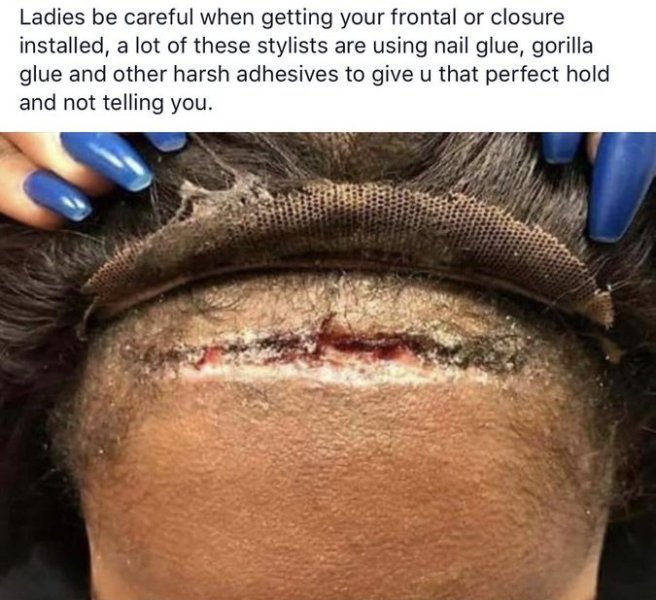
I am hearing more and more about how people in the salon are having there wigs and pieces glued on now with very strong industrial adhesives. Such as gorilla. I would never have thought professionals in the beauty would use such a product. But they are. This can be a health risk for women and also can lead to severe skin disfiguration. Now the cost of beauty should not be that high. And the wants and needs of a individual should not be so reckless.  Special effect makeup uses alot of industrial glues, but the safe thing about it they apply a scalp mask first. This way it is in no contact with the human skin. These glues are very very strong and also flammable. Imagine smoking with this applied to your scalp and you catch on fire, even smelling the fumes could be a serious hazard to some people.

Here is a interesting mishap I found on ModelMayhem.com check it out ladies.

“My neighbor (seriously, it isn’t me) has accidentally got Gorilla Glue on her hair and scalp. She is now trying to get it out. She called the manufacturer and their customer service told her to put baby oil on it and then wash it without rubbing it. Personally, I would go with what the manufacturer says but she is afraid to put water on it because the last time she had a Gorilla Glue mishap (really, how many Gorilla Glue accidents can you have in one summer?), when she glued a tile in the wrong location, customer service told her that water would make it set forever. She has put coconut oil on it as she didn’t have any baby oil. She has waist length hair and doesn’t want to cut it. She asked me what to do and I said I would ask around.”

Don’t use it everyone it’s not worth it!