Van Tibolli Beauty Corp Issued Warning Letter AKA “GK Hair Taming System with JUVEXIN®”

 THE REAL HAIR TRUTH
WARNING LETTER
FLA-15-31
September 2, 2015
Mr. Van Tibolli, CEO
Van Tibolli Beauty Corp.
4800 NW 15th Avenue, Unit E
Fort Lauderdale, FL 33309-3781
THE REAL HAIR TRUTH
Dear Mr. Tibolli:
The United States Food and Drug Administration (FDA) has reviewed the regulatory status of your products, the GK Hair Taming System with JUVEXIN® Curly and GK Hair Taming System with JUVEXIN® Resistant hair smoothing products.  The GK Hair Taming System Curly and Resistant products are intended to be applied to the human body for cleansing, beautifying, promoting attractiveness, or altering the appearance, therefore these products are a cosmetic within the meaning of Section 201(i) of the Federal Food, Drug, and Cosmetic Act (the Act) [21 U.S.C. § 321(i)]. As described below, the GK Hair Taming System with JUVEXIN® Curly and GK Hair Taming System with JUVEXIN® Resistant hair smoothing products are adulterated within the meaning of Section 601(a) of the Act [21 U.S.C. § 361(a)] and are misbranded within the meaning of Section 602(a) of the Act [21 U.S.C. § 362(a)]. It is a violation of Section 301(a) of the Act [21 U.S.C. § 331(a)] to introduce or deliver for introduction into interstate commerce any cosmetic that is adulterated or misbranded. You can find copies of the Act and its implementing regulations through links on FDA’s home page at http://www.fda.gov.
Adulterated Cosmetics
Under Section 601(a) of the Act [21 U.S.C. § 361(a)], a cosmetic is adulterated if it bears or contains any poisonous or deleterious substance which may render it injurious to users under the conditions of use prescribed in the labeling thereof, or, under such conditions of use as are customary or usual.  The conditions of use in the product labeling fail to include instructions to: (1) use these products in a facility with adequate ventilation, (2) avoid direct eye and skin contact, and (3) avoid unnecessary repeated use.
The GK Hair Taming System with JUVEXIN® Curly and Resistant products are adulterated cosmetics within the meaning of Section 601(a) of the Act, 21 U.S.C. § 361(a) because they bear or contain a deleterious substance that may render it injurious to users under the conditions of use prescribed in your labeling. Specifically, based on product labeling and FDA sample analysis, the GK Hair Taming System with JUVEXIN® Curly and Resistant products contain methylene glycol, the liquid form of formaldehyde, which, under the conditions of use prescribed in the product labeling, releases formaldehyde when hair treated with the product is heated with a blow dryer and then with a hot flat iron.  Methylene glycol is a deleterious substance, under the conditions of use prescribed in the current labeling.  FDA analysis of approximately 50 mg samples of the GK Hair Taming System with JUVEXIN® Curly and Resistant confirmed the presence of 3.9 % and 4.85% methylene glycol, the liquid form of formaldehyde, respectively.
FDA notes that the primary route of exposure to formaldehyde, when using the GK Hair Taming System with JUVEXIN® Curly and Resistant products under the conditions of use prescribed in the labeling, is through inhalation.  Formaldehyde is a highly reactive chemical that readily reacts with biological tissues, particularly the mucous tissues lining the respiratory tract and the eyes.  Formaldehyde is a recognized carcinogen. For example, adverse events have reported the following injuries associated with formaldehyde containing hair smoothers: eye disorders (irritation, increased lacrimation, blurred vision, hyperaemia); nervous system disorders (headache, burning sensation, dizziness, syncope), and respiratory tract (dyspnea, cough, nasal discomfort, epistaxis, wheezing, rhinorrhea, throat irritation, nasopharyngitis).  Other reported symptoms included nausea, hypotrichosis, chest pain, chest discomfort, vomiting, and rash.
Misbranded Cosmetics
In addition, under Section 602(a) of the Act [21 U.S.C. § 362(a)], a cosmetic is misbranded if its labeling is false or misleading in any particular.  Section 201(n) of the Act [21 U.S.C. § 321(n)] provides that, in determining whether a product’s labeling or advertising is misleading “there shall be taken into account (among other things) the extent to which the labeling or advertising fails to reveal facts material with respect to consequences which may result from the use of the article to which the labeling or advertising relates under the conditions of use prescribed in the labeling or advertising thereof or under such conditions of use as are customary or usual.” Specifically, the GK Hair Taming System with JUVEXIN® Curly and Resistant products are misbranded because the product labels and labeling, including instructions for use, fail to reveal material facts with respect to consequences that may result from the use of the product.
FDA notes that the product labels for the GK Hair Taming System with JUVEXIN® Curly and Resistant declare the following:
  • “INSTRUCTIONS: Shampoo client’s hair twice using GKhair pH+ Shampoo.  Apply, then massage product ¼ inch from the root.  Comb for even distribution.  Blow dry client’s hair straight and smooth until 100% dry.  Flat iron to seal cuticle.  For detailed instructions visit http://www.GKhair.com.”
  • “WARNING: Product releases formaldehyde.  Information on the physical and health hazards, and the safety data sheet, may be obtained from Van Tibolli Beauty S.a.r.l.  This product must be applied by hair professionals only.  If you are nursing or pregnant do not use the product without first consulting your physician.  If skin contact occurs, wash immediately.  If ingestion or eye contact occurs, call a physician immediately.  Salon professional and client must wear protective clothing.  Keep out of reach of children.  Store in a cool and dry place.”
Although the GK Hair Taming System with JUVEXIN® Curly and Resistant product labels bears a warning statement, the warning statement and product labeling are inadequate. Specifically, they fail to reveal facts material with respect to consequences that may result from this use of these products under the conditions of use as follows:
1.    They fail to inform the user of the adverse effects that may result from the release of formaldehyde into the air during the heating process, which can have both short term and long term health effects (e.g., eye and throat irritation, headache, dizziness, burning sensations, breathing problems, nosebleeds, chest pain, skin irritation and certain cancers), particularly for those who are sensitive to formaldehyde.  Long term exposure may potentially cause certain cancers.
2.    They fail to inform users that concurrent uses of these products in the same facility may increase the concentration of formaldehyde in the air, which could increase the risk of adverse effects.
We also note that while the GK Hair Taming System is targeted primarily for use by salon professionals in a salon setting, the product may also be used in home salon settings as the GK Hair Taming System with JUVEXIN® Curly and Resistant hair smoothing products are also available for purchase in beauty retail stores and via the internet by the general public. Consequently, we recommend that Van Tibolli Beauty Corp. work with its distributors to ensure that GK Hair Taming System with JUVEXIN® Curly and Resistant products are labeled in accordance with the requirements of the Act.
The violations cited in this letter are not intended to be an all-inclusive list of the violations that exist in connection with your products. You are responsible for investigating and determining the causes of the violations identified above and for preventing their recurrence or the occurrence of other violations. It is your responsibility as a manufacturer to ensure that the products your firm markets are safe and otherwise in compliance with all applicable legal and regulatory requirements. You should take prompt action to correct the violations cited in this letter. Failure to do so may result in enforcement action without further notice, including, but not limited to, seizure and/or injunction.
Please advise this office in writing within fifteen (15) working days from your receipt of this letter as to the specific steps you have taken to correct the violations noted above and to assure that similar violations do not occur in the future. Your response should include any documentation necessary to show that correction has been achieved. If you cannot complete all corrections before you respond, please explain the reason for your delay and the date by which each item will be corrected and documented.
Your response should be sent to:
Salvatore N. Randazzo, Compliance Officer
555 Winderley Place, Suite 200
Maitland, Florida, 32751
Refer to the Unique Identification Number 451478 when replying. If you have any questions about the content of this letter please contact: Salvatore N. Randazzo at (407) 475-4712.
Sincerely,
/S/
Susan M. Turcovski
District Director
Florida District Office
Illegal Cancer-Causing Chemicals Found in Nearly 100 Shampoo Brands! Oh My Lawd!

The Real Hair Truth

Cocamide Diethanolamine (cocamide DEA), a controversial ingredient found in body care items, has landed four personal care manufacturers with a lawsuit in California.

The Center for Environmental Health filed the suit after discovering the presence of cocamide DEA, the foam stabilizer and voluminous, in shampoos and soaps. In the state of California, Proposition 65 requires manufacturers to warn consumers over the risks of certain substances. Cocamide DEA is on that list because it is a suspected carcinogen. It was banned in the state last year after a study found it caused cancer in laboratory animals.

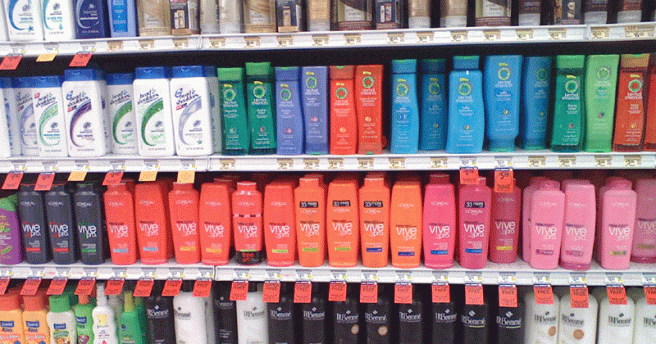
Some of the products that contain high levels of the illegal chemical are sold under well-known companies such as Colgate Palmolive, Paul Mitchell, and Prell. Lab tests also found the carcinogen in children’s products, such as a store brand bubble bath from Kmart, and a shampoo/conditioner from Babies R Us. Other store brand products that contain the carcinogen came from Trader Joe’s, Walmart, and Kohl’s.

Unfortunately, manufacturers can put any toxic chemical they want into shampoos because  the FDA allows all sorts of chemicals to be used in these products, including chemicals that are known carcinogens and that contribute to liver failure and nervous system disorders. How’s that for protecting public health?  NADA it won’t change? Get over it! I guess profit is more important to them than the health of their customers. After all, it’s safe to say that many of these CEOs and top executives have ties to Big Pharmaceutical stock, so the fact that their products make people sick is a real win-win for their bank accounts.


In The Beauty Industry The Scum Always Rises To The Top

The Real Hair Truth.com

U.S. Department of Education Takes Enforcement Against Two School Ownership Groups!

Office of Federal Student Aid issues letters denying re certification applications for Title IV eligibility to several Marinello Schools of Beauty and Computer Systems Institute locations
February 1, 2016
As part of the Obama Administration’s ongoing commitment to protect students and increase accountability and transparency in higher education, the U.S. Department of Education is taking action to end the participation in the federal student financial assistance programs of 23 Marinello Schools of Beauty (Marinello) campuses in Nevada and California and three Computer Systems Institute (CSI) campuses in Illinois.

Investigations by the Department’s Office of Federal Student Aid (FSA) uncovered serious violations within both institutions. The Department determined that CSI submitted false job placement rates to its students, the Department, and its national ac-creditor, the Accrediting Council for Independent Colleges and Schools (ACICS). The Department determined that Marinello was knowingly requesting Federal aid for students based on invalid high school diplomas, under awarding Title IV aid to students, charging students for excessive overtime, and engaging in other acts of misrepresentation.

“Our students depend on higher education institutions to prepare them for careers through a quality education. Unfortunately, some schools violate their trust through deceptive marketing practices and defraud taxpayers by giving out student aid inappropriately. These unscrupulous institutions use questionable business practices or outright lie to both students and the federal government,” said Under Secretary Ted Mitchell. “In these cases we are taking aggressive action to protect students and taxpayers from further harm by these institutions.”

The Department is denying pending recertification applications for five Marinello locations covering 23 campuses in five cities and enrolling about 2,100 active students.

The campuses are:

  • Las Vegas, Nevada (2 Locations; 209 active students)
  • Los Angeles, California (14 locations; 1,277 active students)
  • Burbank, California (2 locations; 255 active students)
  • Moreno Valley, California (2 locations; 115 active students)
  • Sacramento, California (3 locations; 244 active students)

In addition, the Department previously placed all Marinello schools on Heightened Cash Monitoring 2, which is a step taken by FSA to provide additional oversight of institutions to safeguard taxpayer dollars.

The Department is also denying a pending re certification application from CSI, which enrolls about 2,600 active students.

The letters to the Marinello schools and CSI provide an opportunity for the institutions to submit factual evidence to dispute the Department’s findings. The Marinello schools have until February 16, 2016, to submit such evidence; CSI has until February 12, 2016, to do so. If submitted evidence causes the Department to change its determination, the schools could be able to continue participating in the federal financial aid programs.

The entire Marinello school chain – with 56 campuses across the nation – received more than $87 million in Pell Grants and federal loans for the 2014–15 award year.

Collectively, CSI campuses received approximately $20 million in federal funding for the 2014-15 award year.

For more information about today’s action, please visit StudentAid.gov/sa/about/announcements/marinello and StudentAid.gov/sa/about/announcements/csi.

“Your skin is too dark.” 1950’s Racial Advertising

realhairtruth.com


In America, the perennial quest for beauty is an expensive one.

Every year, women spend billions of dollars in exchange for beautiful hair, luxurious eye lashes, and smooth, silky skin. Still, many of our culture’s most common beauty procedures were virtually nonexistent a century ago. The truth is, many of our expectations of feminine beauty were shaped in large part by modern advertisers. We’ve tracked the history behind some of the most common “flaws” that besiege the modern woman and the surprising stories behind their “cures.”

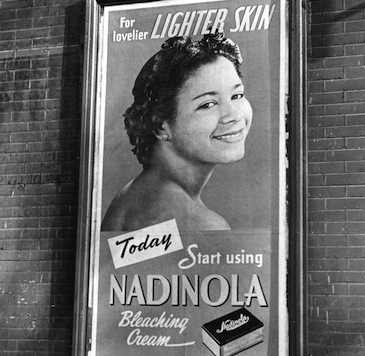
During the late-19th century and early-20th century, skin lightening became popular with black women. Skin bleaching was seen as more than a beauty ritual — it was a symbolic way to progress in a prejudiced society, where lighter-skinned black people encountered comparatively better treatment. Advertisers exploited those prejudices in the beauty industry, promising women that they could “occupy more positions socially and commercially” marry better, “get along better” and be more beautiful with lighter skin. In this 1944 ad, lighter skin is equated with “lovelier” skin:

Advertisement for Nadinola bleaching cream, 'for lovelier lighter skin,' New York, New York, 1944. (Photo by Fred Stein Archive/Archive Photos/Getty Images)

The actual products were seriously dangerous: Most contained the chemical hydroquinone which is also used to develop photographs. (The chemical has been banned in Australia, the EU, and Japan, but remains legal in the United States)

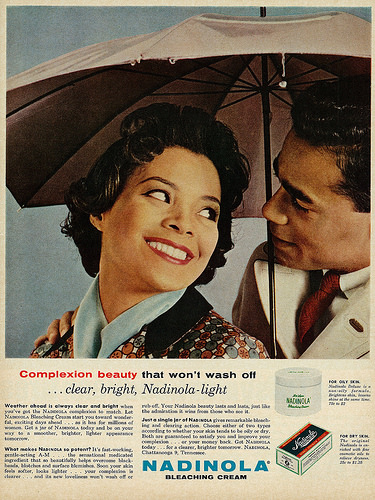
During the ’60s and ’70s, the skin marketing popularity dipped in the 1970’s as the “Black is Beautiful” movement grew. The movement encouraged black people to embrace their natural features, rather than attempt to conform to white beauty norms. Cosmetic companies quickly softened their rhetoric, and the phrase “skin lightening” was changed to the somewhat more innocuous term “skin brightening.” The smiling 1962 ad below promises bright, light skin even on the rainiest day while neglecting to mention the possible side effect of mercury poisoning.  Today, skin lightening continues to be practiced around the world, with particular popularity in Africa, India and Pakistan. The annual global market is expected to reach $10 billion by 2016, though many of the products come with serious health risks.

7 Ways The Beauty Industry Convinced Women That They Weren’t Good Enough

Jotovi Designs Inc

In America, the perennial quest for beauty is an expensive one.

Every year, women spend billions of dollars in exchange for beautiful hair, lovely lashes, and smooth and silky skin. Still, many of our culture’s most common beauty procedures were virtually nonexistent a century ago. The truth is, many of our expectations of feminine beauty were shaped in large part by modern advertisers. We’ve tracked the history behind some of the most common “flaws” that besiege the modern woman and the surprising stories behind their “cures.”

1. “Your natural hair color isn’t pretty enough.”

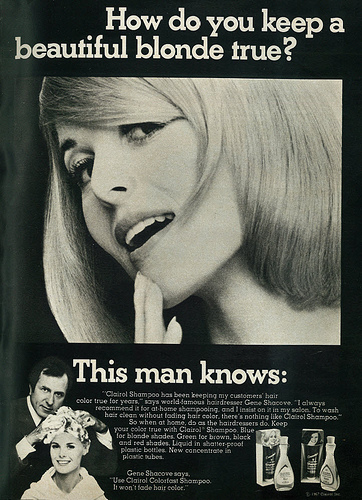
“Does she or doesn’t she?” asked the Clairol’s ad that launched a million home hair dye jobs. Indeed, the aggressive Clairol Marketing would trigger an explosion in sales. In the process, the percentage of women dyeing their hair would skyrocket from 7 percent to more than 40 percent in the ’70s.

The ads showed everyday women reaping the benefits of more lustrous hair, a luxury that had long been exclusive to glamorous supermodels with professional dye jobs. The ads proclaimed, “If I have only one life, let me live it as a blonde.” Indeed, Clairol peddled the perfect yellow shade of the dye as a way to transform your life:

realhairtruth.com

Clairol hair dye offered self reinvention, in 20 minutes flat, particularly for women who didn’t want to reveal their true age or grey roots.

realhairtruth.com

Shirley Polykoff, the advertising writer behind Clairol’s goldmine campaign, described her plan as such: “For big success, we’d have to expand the market to gather in all those ladies who had become stoically resigned to [their gray hair]. This could only be accomplished by reawakening whatever dissatisfaction’s they may have had when they first spotted it.” Clairol did that with ads like, “How long has it been since your husband asked you out to dinner?” Nowadays, about 90 million women in the U.S. color their hair.