Why Do You Use Gorilla Glue?

I am hearing more and more about how people in the salon are having there wigs and pieces glued on now with very strong industrial adhesives. Such as gorilla. I would never have thought professionals in the beauty would use such a product. But they are. This can be a health risk for women and also can lead to severe skin disfiguration. Now the cost of beauty should not be that high. And the wants and needs of a individual should not be so reckless.  Special effect makeup uses alot of industrial glues, but the safe thing about it they apply a scalp mask first. This way it is in no contact with the human skin. These glues are very very strong and also flammable. Imagine smoking with this applied to your scalp and you catch on fire, even smelling the fumes could be a serious hazard to some people.
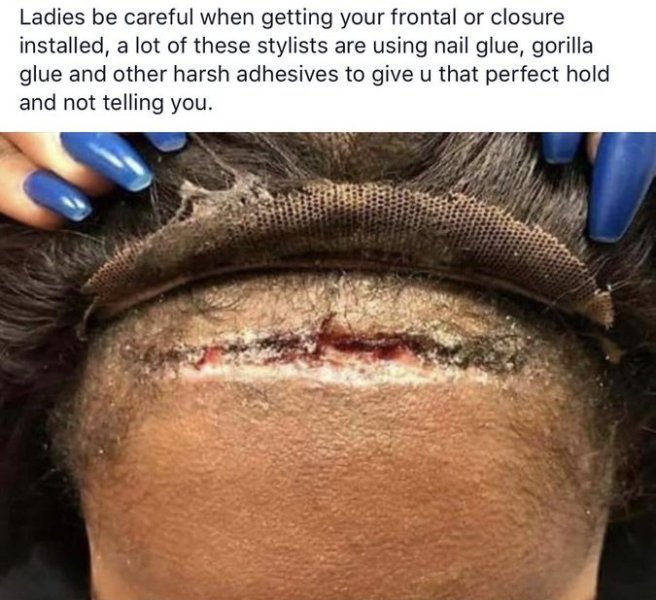
Here is a interesting mishap I found on ModelMayhem.com check it out ladies.

“My neighbor (seriously, it isn’t me) has accidentally got Gorilla Glue on her hair and scalp. She is now trying to get it out. She called the manufacturer and their customer service told her to put baby oil on it and then wash it without rubbing it. Personally, I would go with what the manufacturer says but she is afraid to put water on it because the last time she had a Gorilla Glue mishap (really, how many Gorilla Glue accidents can you have in one summer?), when she glued a tile in the wrong location, customer service told her that water would make it set forever. She has put coconut oil on it as she didn’t have any baby oil. She has waist length hair and doesn’t want to cut it. She asked me what to do and I said I would ask around.”

Don’t use it everyone it’s not worth it!
Are Your Favorite Retailers Taking Action on Toxics?

Taken from the website, Mind The Store.

In our second annual report card on toxic chemicals in consumer products, the Mind the Store Campaign found that one-third of 30 major U.S. retailers are leaders, but two-thirds are seriously lagging behind. Find out how the stores where you shop are (or are not) tackling toxic chemicals in everyday products. Click on any of the logos below to learn more about each company, read our report, and raise your voice as a consumer!

Ulta Beauty earned a grade of D-, scoring 18.5 out of 135 possible points, ranking it 20th out of 30 retailers evaluated. Ulta Beauty has started taking some actions to address toxic chemicals in the products it sells, but still has much room for improvement. The company earned points for making efforts in recent years to require the suppliers of its private label products to eliminate chemicals of high concern identified in a private list that goes beyond legal requirements as new products are added and existing products reformulated. This list includes prohibitions on parabens, formaldehyde releasing preservatives, BHA & BHT, alkylphenol ethoxylates, and toluene and xylene in nail products. Unfortunately, Ulta has made little of this information public, only sharing limited, non-quantified information with us for the purposes of this report. While it labels its reformulated products as “free from” specific chemicals, this information is not readily searchable on its website or displayed in store, making it difficult for consumers to identify safer products. Ulta does not appear to be taking action with suppliers outside of those producing its private label brands.

Opportunities for improvement: Ulta can make progress by making more information publicly available, setting public and quantifiable goals with clear timelines for reducing and eliminating chemicals of high concern, and starting to work with suppliers other than those of its private label goods to reduce chemicals of high concern. Ulta should also become a signatory to the Chemical Footprint Project and pilot it with key private label suppliers. Since the U.S. Food and Drug Administration already requires disclosure of ingredients on cosmetic products, Ulta should go beyond compliance with this requirement by working to disclose the ingredients in fragrances and close other loopholes in the mandatory labeling requirements to demonstrate a greater commitment to transparency.

Are Your Favorite Retailers Taking Action on Toxics?

Important to know from the website Mind The Store.

In our second annual report card on toxic chemicals in consumer products, the Mind the Store Campaign found that one-third of 30 major U.S. retailers are leaders, but two-thirds are seriously lagging behind. Find out how the stores where you shop are (or are not) tackling toxic chemicals in everyday products. Click on any of the logos below to learn more about each company, read our report, and raise your voice as a consumer!

Wal-Mart Stores (Walmart and Sam’s Club) earned a grade of A-, improving from a B+ in 2016, and scoring 87.5 out of 135 possible points, the 2nd highest score of any retailer evaluated. In 2017, the company made significant progress in both implementing and expanding their chemical policy, which includes a greater focus on the larger list of 2,700 chemicals, which grew by adding two new authoritative lists of fragrance chemicals of concern. Most recently, Walmart stated a new goal: by “2022, Walmart aims to reduce its consumables chemical footprint for Walmart U.S. and Sam’s Club U.S. stores by 10 percent” which translates to a reduction of toxic chemicals of 55 million pounds. Since 2014, Walmart has reduced the use of “High Priority” chemicals by 96% by weight. The company states that: “All suppliers are expected to reduce, restrict and eliminate use of priority chemicals using informed substitution principles.” The policy applies to cleaning products, cosmetics and personal care products, infant products, and pet supplies, covering approximately 90,000 products and 700 suppliers. The company’s Implementation Guide provides comprehensive guidance to suppliers on how they should work with Walmart to implement the policy. In October 2016, Walmart unveiled its “Sustainable Packaging Playbook,” which also encourages suppliers to identify, restrict, and remove its priority chemicals from packaging, while avoiding polyvinyl chloride (PVC or vinyl) plastic in packaging.

Opportunities for improvement: Walmart can continue to improve its safer chemicals program by setting a more ambitious Chemical Footprint reduction goal going beyond 10%, expanding the policy to include key chemically intensive product categories such as apparel, electronics, and furniture, piloting the Chemical Footprint Project with key private label suppliers, and reducing priority chemicals in use by Sam’s Club, which grew 13% by weight since 2014.

Take Action To Clean Up The Beauty Aisle!


Dear friends

When we buy products that we put on our skin, faces and hair, we rightfully expect that they are free of toxic chemicals that increase our risk of breast cancer or  reproductive health problems. But think again.

A recent report card from our partners at Mind the Store shows that retailers Sally Beauty, Ulta Beauty, and Sephora, are failing to address cancer-causing chemicals in the cosmetic and personal care products they sell. Take action to clean up the beauty aisle!

Companies can and should make safer products, sell safer products, and make ingredient transparency a priority. Following pressure from consumers like you, companies like Target, Walmart, CVS Health, and Costco announced policies to get toxic chemicals off their store shelves last year.

Tell these beauty retailers to get their act together!

As more and more families are devastated by a cancer diagnosis, it’s more important than ever to focus on prevention. That’s why we believe – and think you do too – that chemicals that can cause cancer have no place in the products we use to clean and care for our bodies.

Please take action to tell these retailers to stop selling beauty products made with toxic chemicals. Because body care products shouldn’t cost us our health!

Thank you for your own good work on this issue,

Janet

Janet Nudelman
Director of Program & Policy, Breast Cancer Prevention Partners
Director, Campaign for Safe Cosmetics 415-321-2902 (direct)

P.S. Donate HERE to support our work to hold beauty retailers and other corporations accountable for product safety and transparency.